
IP ratings for panels: what IP54, IP65 and IP66 survive
What each digit is tested against, why a higher rating derates your busbars, and the condensation problem that ruins sealed outdoor enclosures.
IP ratings get specified by reflex. Outdoor panel, so IP65. Indoor panel, so IP54. Occasionally IP66 because the specification writer wanted to be safe.
Two digits, two independent tests, and one important consequence nobody mentions: every step up in ingress protection costs you heat. A sealed enclosure cannot shed the heat its own busbars generate, and the derating that follows is larger than most people expect.
What the digits mean
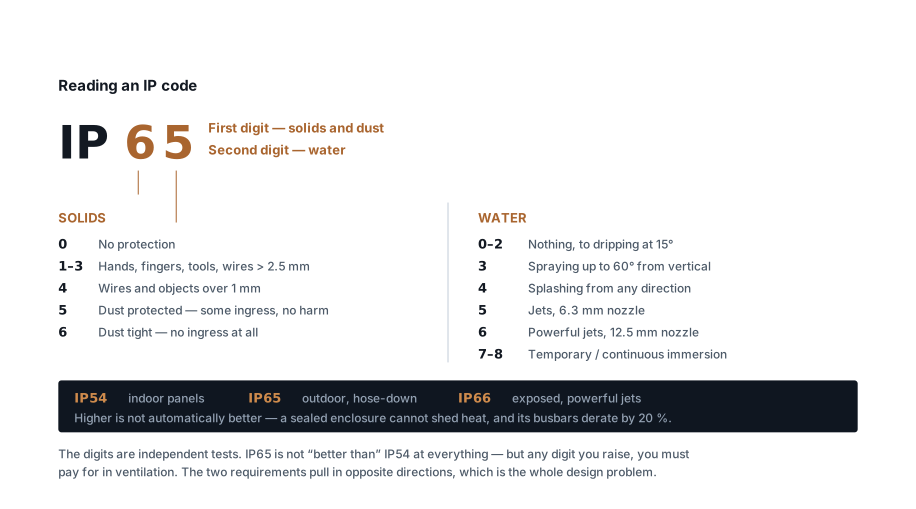
First digit — solid objects and dust:
| Digit | Protected against |
|---|---|
| 0 | Nothing |
| 1 | Objects over 50 mm — the back of a hand |
| 2 | Objects over 12.5 mm — a finger |
| 3 | Objects over 2.5 mm — tools, thick wire |
| 4 | Objects over 1 mm — most wires and screws |
| 5 | Dust protected — some dust enters, not enough to interfere |
| 6 | Dust tight — no ingress at all |
Second digit — water:
| Digit | Tested with |
|---|---|
| 0 | Nothing |
| 1–2 | Dripping water, vertical and at 15° |
| 3 | Spraying up to 60° from vertical — effectively rain |
| 4 | Splashing from any direction |
| 5 | Jets from a 6.3 mm nozzle |
| 6 | Powerful jets from a 12.5 mm nozzle |
| 7 | Temporary immersion to 1 m |
| 8 | Continuous immersion, conditions agreed with the maker |
They are separate tests, so a rating is not a single scale. Note also that digits 7 and 8 do not imply 5 and 6 — an enclosure that survives immersion has not necessarily been tested against a pressure jet, which is why you occasionally see a dual marking like IP66/IP68.
What to specify, where
| Location | Rating | Notes |
|---|---|---|
| Clean indoor plant room | IP42 – IP54 | IP54 is the sensible default |
| Dusty industrial indoor | IP54 – IP65 | Textile, cement, flour: dust tight matters more than water |
| Outdoor, sheltered | IP54 – IP65 | Under a canopy, IP54 with a rain hood is often enough |
| Outdoor, fully exposed | IP65 – IP66 | Plus UV-stable paint and a sun shield |
| Washdown — food, pharma | IP66 – IP69K | Hose-down and steam cleaning are the design case |
| Coastal | IP65 plus 316 stainless | The rating says nothing about corrosion |
That last row is worth dwelling on. IP is an ingress test, not a corrosion test. A powder-coated mild steel IP66 enclosure on a coastal site will rust through while remaining perfectly IP66 until it does. Corrosion is a material specification — 316 stainless, marine-grade coating, or GRP — and it is separate.
The related rating for physical abuse is IK, from IK00 to IK10, covering impact energy. On a panel anywhere a forklift can reach, IK10 is worth more than another IP digit.
The heat problem
Here is the trade-off nobody puts in the specification.
Busbar and cable ratings assume the ambient air around them. Inside a working panel that air is hotter than the room — typically 10–15 °C hotter — because everything inside is dissipating heat and the enclosure is in the way.
| Enclosure | Busbar derating |
|---|---|
| Open / free air | 1.00 |
| Ventilated enclosure | 0.90 |
| Sealed IP54 and above | 0.80 |
Combine a sealed enclosure with a 50 °C internal ambient and you are at 0.80 × 0.90 = 0.72. Nearly a third of the busbar rating gone, and none of it visible on a drawing that says "1600 A busbar, IP65". Work it through with the busbar sizing calculator using the internal ambient, not the room temperature.
The ways out, in order of preference:
- Reduce the heat. Fewer losses inside — properly torqued joints, correctly sized bars, no oversized transformers sitting in the same enclosure.
- Increase the surface. A larger enclosure sheds more heat for the same losses, and it costs less than active cooling.
- Filtered forced ventilation. Fan and filter units keep IP54 while moving air. Filters need cleaning, and a blocked filter is worse than no fan.
- Air conditioner or heat exchanger. Preserves IP65/66 and adds a maintenance item and a failure mode. Necessary above a certain loss density, but it is the last resort, not the first.
Condensation ruins sealed outdoor panels
This is the failure that surprises people, because the panel is doing exactly what was specified.
A sealed enclosure outdoors heats during the day and cools at night. The air inside contains moisture. As it cools past the dew point, that moisture condenses on the coldest surfaces — which are the metal parts. Water forms inside an IP66 enclosure that no rain ever entered.
Over months it corrodes terminals, tracks across insulation and eventually causes a fault. And because the enclosure is sealed, the water cannot get out either.
The fixes:
- Breather drains. A membrane vent at the lowest point equalises pressure and lets moisture out while maintaining the IP rating. Cheap, and routinely omitted.
- Anti-condensation heaters with a hygrostat, sized to hold the interior a few degrees above ambient. Standard on outdoor panels in humid climates.
- Sun shields. A second skin with an air gap over the roof and sunny side cuts the daily temperature swing that drives the whole cycle.
- Gland from below. Bottom entry with correctly rated glands, so gravity is working with you.
The rating is only as good as its weakest hole
A panel is rated as an assembly. Every penetration has to match:
- Cable glands must carry their own IP rating, and unused gland plate holes must be blanked with rated plugs — not tape.
- Door gaskets are a wear item. A gasket that has taken a set no longer seals, and a door that has been forced no longer closes on it evenly.
- Door-mounted devices — meters, pushbuttons, indicator lamps, HMIs — each have their own front-face rating, and they are frequently the lowest number on the panel. An IP66 enclosure with IP54 pushbuttons is an IP54 panel.
- Ventilation louvres cap the rating at whatever they were tested to.
When you specify a rating, specify it for the complete assembly including door furniture, or you will get an enclosure that meets it and a panel that does not.
What IP does not tell you
The code covers solids and water. Everything else about the environment is a separate specification, and each of these has ended panels that were entirely IP-compliant:
- Corrosion. IP is an ingress test, not a material one. A powder-coated mild steel IP66 enclosure on a coastal site rusts through while remaining IP66 until the day it does not.
- Chemicals and solvents. Gasket compounds have chemical compatibility lists. A seal that survives rain may not survive a cleaning agent.
- UV. GRP and plastic enclosures chalk and embrittle in direct sun. The rating says nothing about it.
- Impact. That is the IK code, IK00 to IK10. Anywhere a forklift can reach, IK10 is worth more than another IP digit.
- Temperature and altitude. Both derate what is inside, and neither appears in the marking.
If you also work to NEMA
Indian and international projects mix the two schemes, and they are not directly interchangeable — NEMA includes corrosion and construction requirements that IP does not test, so a NEMA type implies an IP rating but not the reverse. As a working cross-reference:
| NEMA | Roughly | Use |
|---|---|---|
| 1 | IP20 | Indoor, incidental contact only |
| 12 | IP54 | Indoor industrial, dust and dripping |
| 3R | IP24 | Outdoor, rain and sleet |
| 4 | IP66 | Outdoor, hose-directed water |
| 4X | IP66 + corrosion | As above, stainless or non-metallic |
| 6P | IP67 | Prolonged submersion |
Specify one scheme and state it. A drawing carrying both, with figures that do not correspond, is how a supplier ends up choosing whichever is cheaper.
Before you write IP65 on a drawing
- What is the actual exposure — rain, hose, dust, steam?
- What is the corrosion environment? That is a separate specification.
- What are the internal losses, and what internal ambient do they produce?
- Have the busbars and cables been derated for that ambient?
- Is there a condensation strategy — breather, heater, shield?
- Do the door-mounted devices and glands meet the same rating?
- Is impact a risk? Then specify IK as well.
Higher is not automatically better. An over-sealed panel that cooks its own busbars and condenses water on its terminals is a worse installation than a ventilated one that was specified for the conditions it is actually in.
Related articles
More on panels, protection & earthing.
 Panels, protection & earthing
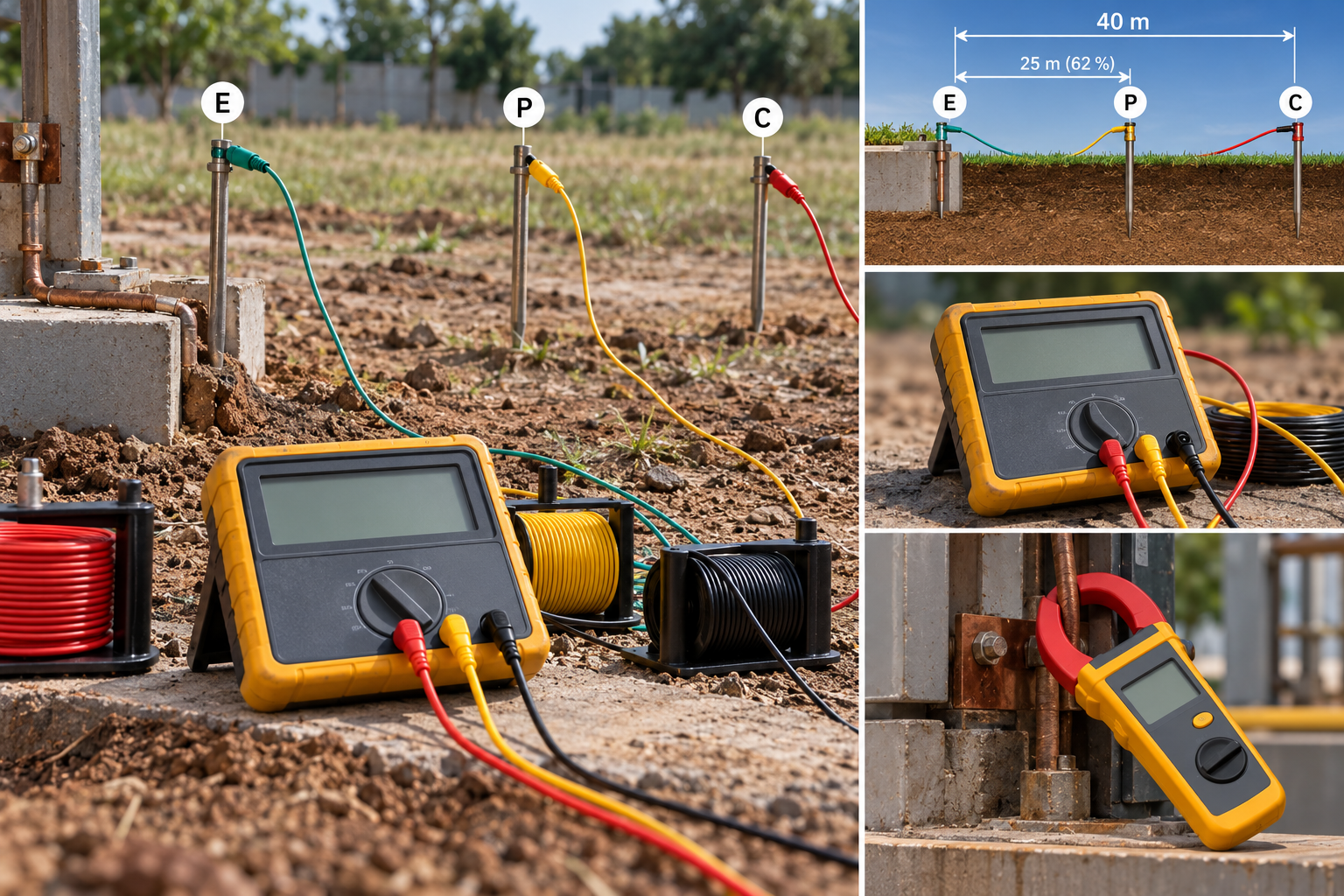
Earth resistance testing: the 62 % rule, and when the clamp-on lies
Fall-of-potential done properly, the three-position check that proves it, IS 3043 limits by application, and when a clamp-on tester measures nothing.
8 min read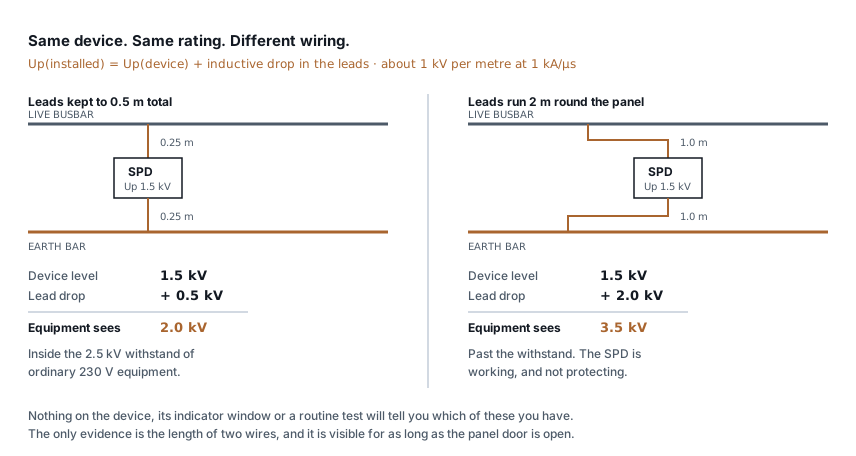 Panels, protection & earthing
SPD installation: the two wires that decide
An SPD with 2 m of lead passes more than twice the voltage it should. Lead length, Uc and type selection, and how to check a panel you did not build.
7 min read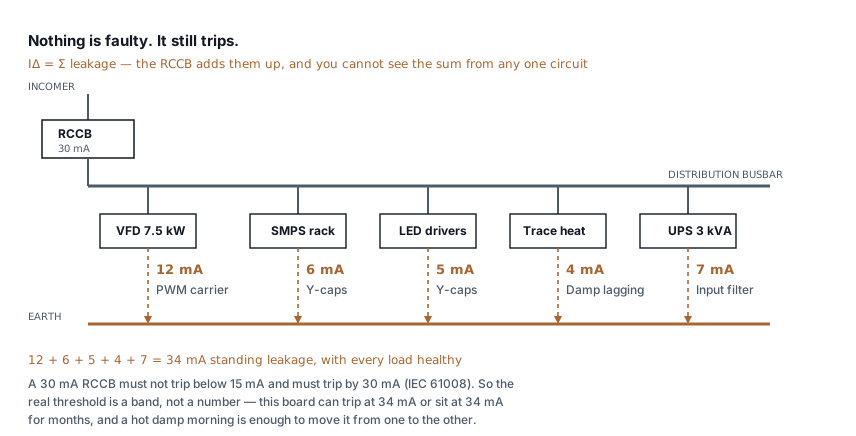 Panels, protection & earthing
RCCB keeps tripping: how to find the leakage
Healthy loads leak. Six of them on one board can trip a 30 mA RCCB with nothing faulty anywhere. How to measure the standing leakage and what to change.
8 min read Panels, protection & earthing
Types of earthing: plate, pipe, rod and chemical compared
Plate, pipe, rod and chemical earthing all obey one formula. What separates them is soil resistivity, depth and who maintains them — not the electrode material.
7 min read
Comments
Loading…