
Cable size for large loads: when to run cables in parallel
Above 300 mm², a bigger cable size stops paying. When to run cables in parallel, the six rules for equal sharing, and the overload no breaker can see.
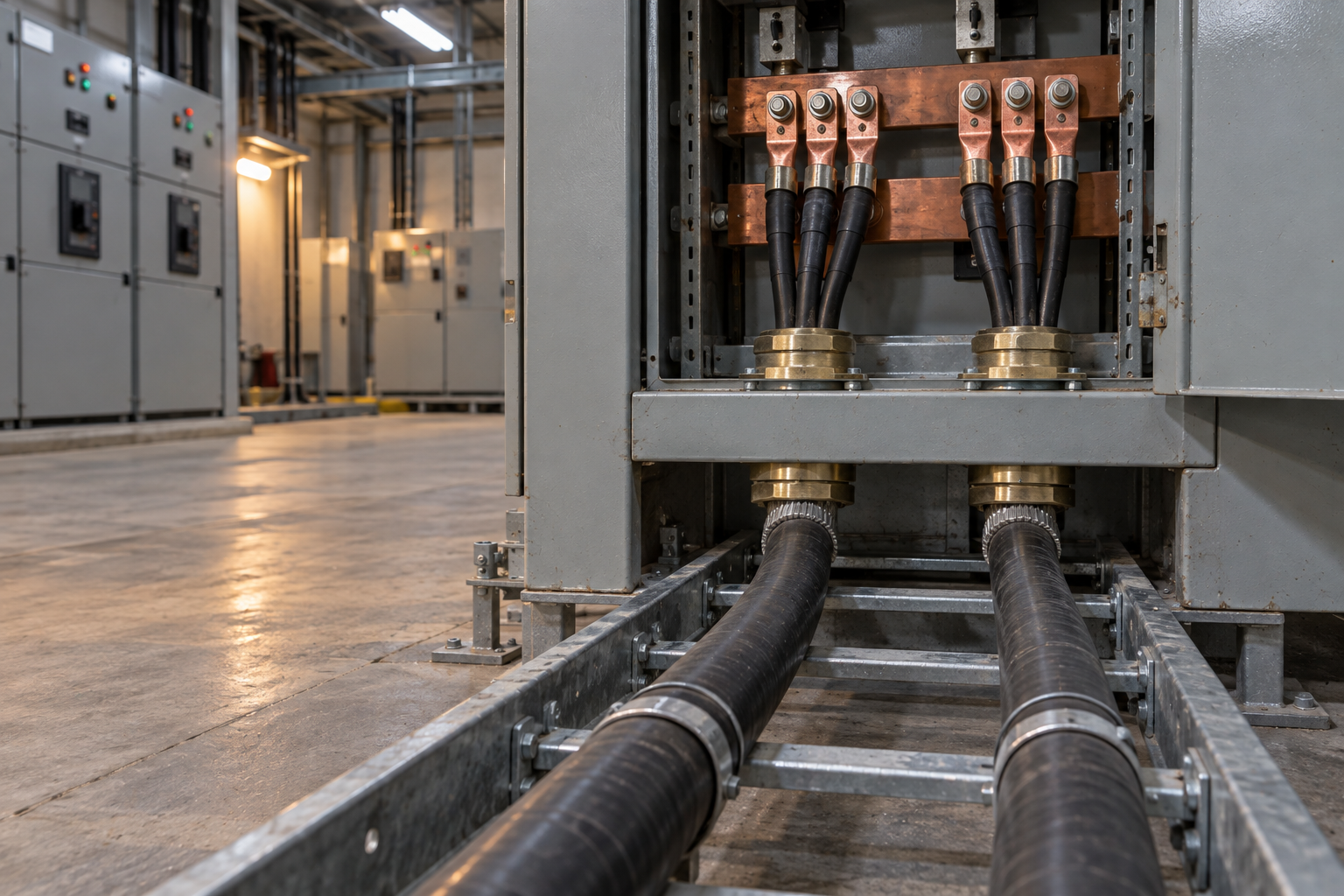
There is a cable size above which buying a bigger cable stops working. Not because the table runs out, but because every property you want starts getting worse per rupee spent: the current rating per square millimetre falls, the bending radius exceeds the space in front of the panel, and the cable arrives on a drum nobody on site can move.
Somewhere around 300 mm² the answer to "what cable size do I need?" changes from "one bigger cable" to "two smaller ones". That switch has its own rules, and getting them wrong produces an installation that passes every calculation and runs one of the two cables permanently overloaded.
Why a bigger cable size stops paying
Current rating does not scale with cable size. Heat leaves a cable through its surface, and surface area grows with the diameter while conductor area grows with the square of it. Double the copper and you get nothing like double the rating.
Representative figures for XLPE copper in free air, to show the shape rather than to size anything:
| Size | Rating | Rating per mm² |
|---|---|---|
| 95 mm² | ~290 A | 3.05 A/mm² |
| 185 mm² | ~450 A | 2.43 A/mm² |
| 300 mm² | ~610 A | 2.03 A/mm² |
| 400 mm² | ~720 A | 1.80 A/mm² |
| 630 mm² | ~950 A | 1.51 A/mm² |
Take the real numbers from IS 732 or the manufacturer's tables, or run it through the cable sizing calculator. The pattern is what matters: by 630 mm² you are buying half the amps per millimetre that you got at 95 mm².
So two 185 mm² cables carry more current than one 400 mm² — roughly 900 A against 720 A — for 30 mm² less copper. Before labour, before the bending radius, before the fact that two 185s can be pulled by hand and a 400 needs equipment.
Add the practical constraints and the case is usually settled:
- Bending radius. Typically 8 to 12 times overall diameter for armoured XLPE. A 400 mm² four-core needs something over half a metre of clear space to turn into a gland plate. Panels are rarely designed with that.
- Termination. Lugs at 400 mm² and above are large, the crimping tools are hired rather than owned, and the busbar has to be drilled to suit.
- Handling. Drum weight and pulling tension both become a method statement rather than a task.
Aluminium shifts the crossover point but not the shape of the curve — see copper or aluminium for where that argument lands.
The conditions, and they are not optional
IS 732, following IEC 60364-5-52, permits parallel conductors only where the current divides between them substantially equally. Everything below exists to make that true:
- Same cross-sectional area. No mixing a 185 with a 240 to make up a shortfall.
- Same conductor material. Never one copper and one aluminium.
- Same construction and insulation type. Same manufacturer where you can.
- Same length, measured including the tails at both ends.
- Same route and installation method. Not one on tray and one in a duct.
- No branch connections anywhere along the run.
Read that list as one requirement stated six ways: the two cables must have the same impedance. Anything that makes one path different from the other makes it carry a different current.
The failure this prevents
Current divides between parallel paths in inverse proportion to impedance. At small sizes impedance is mostly resistance, and resistance is easy to match. At the sizes where you actually run parallel cables, reactance dominates, and reactance depends on physical spacing and geometry rather than on the conductor.
So two identical cables on the same tray, in different positions relative to each other and to the other phases, have different reactances and carry different currents.
A 60/40 split on a 630 A circuit puts 378 A through a cable sized for 315 A. It does not trip anything. The protective device sees 630 A total and is perfectly happy. The cable simply runs hot for years, the insulation ages at several times the design rate, and it fails early for no reason anybody connects to the day it was installed.
This is the whole reason the conditions exist, and it is why "we ran a second cable to add capacity" is one of the more dangerous sentences in an installation history. A second cable added later, by a different route, of a different size, is not a parallel circuit. It is two unequal paths sharing a load.
For single-core cables the arrangement is part of the design. Two parallel three-phase circuits of single cores should be laid in two trefoil groups — R, Y, B together, then the second R, Y, B together — not in two flat rows of like phases. Grouping like phases together maximises the reactance difference and the force between conductors under fault. Where the run is long, transpose the positions at intervals.
Derating does not go away
Each parallel cable is a heat source next to the others, so the whole group attracts a grouping factor. Two parallel three-core cables is six loaded conductors sitting together, and they heat each other exactly as two separate circuits would.
The bookkeeping differs between codes — some count a parallel set as one circuit for grouping, some count each cable — so check the stated basis of the table you are using rather than assuming. The physics does not care which convention you adopt: six conductors in a bundle run hotter than three.
The practical consequence is that spacing matters more for parallel runs than for anything else on the tray. One cable diameter between them recovers most of the penalty, and it makes the reactances more predictable at the same time. See cable tray sizing for the width that implies.
Protection, and the thing single devices cannot see
One protective device protects the whole parallel set. That is normal, and it has one consequence worth designing around.
If one cable of a pair is damaged and opens, the device still sees the total load current, which is within its rating. The surviving cable now carries all of it — 200 % of what it was sized for — and nothing trips until it fails.
There is no elegant fix at LV beyond making the failure unlikely: common route, common containment, mechanical protection along the whole length, and terminations that cannot be disturbed independently. It is also a reason to avoid parallel runs where the route is exposed to mechanical damage, and to prefer a single larger cable where you can live with it.
For the fault case, each cable carries only its share of the prospective fault current, so the adiabatic check is done on the share — but the check that matters is a fault on one cable, where that cable carries the full current until the device clears. Run both cases through the short-circuit withstand check and the short circuit current calculator.
Voltage drop
This one is straightforward and pleasant. Parallel paths divide the effective mV/A/m by the number of cables:
Volt drop = (mV/A/m ÷ n) × I_total × L / 1000
Two 185 mm² cables have half the volt drop per amp of one 185 mm². Since the voltage drop limit is frequently what governs a long run, parallel cables often solve a volt drop problem more cheaply than going up two sizes. Check it with the voltage drop calculator.
Worked example: cable size for a 630 A feeder
A 630 A feeder to an MCC. 415 V three-phase, 90 m, XLPE copper armoured on perforated tray, ambient 40 °C, three other circuits on the same tray.
Derating: ambient 0.87, grouping (four circuits, touching) 0.79. Combined 0.69.
Required tabulated rating = 630 / 0.69 = 913 A
Single cable. No single four-core cable size in the standard range reaches 913 A after derating. A 630 mm² four-core is around 950 A in free air and falls well short once grouped. The single-cable route effectively does not exist here, which is the usual reason parallel gets chosen — not cost, but the absence of an alternative.
Two cables in parallel. Each carries 315 A, so each needs a tabulated rating of 315 / 0.69 = 457 A. That lands on 185 mm², with a little margin.
Two 185 mm² four-core, same drum where possible, same route, same tray, spaced one diameter, tails cut to the same length at both ends.
Volt drop check. At roughly 0.25 mV/A/m for 185 mm²:
(0.25 / 2) × 630 × 90 / 1000 = 7.1 V
7.1 V on 415 V is 1.7 %, comfortably inside the 5 % allowance for power.
Copper comparison. Two 185s is 370 mm² per phase against a 630 mm² single that would not have worked anyway. Roughly 40 % less copper, cables a team can pull without hired equipment, and terminations that fit the panel.
Before you sign off the cable size
- Both cables the same size, material, type and length, on the same route.
- Tails cut equal at both ends. Unequal tails at the lug are the most common source of unequal sharing, and the easiest to prevent.
- Single-core runs in trefoil groups, not phase-grouped rows.
- Grouping derating applied to the whole set, not to one cable.
- Adiabatic check done for a fault on one cable carrying the lot.
- Tray width sized for spacing, not for a tight fit.
- A note in the handover file saying this is a parallel circuit, so that the next person to need capacity does not add a third cable of a different size.
Frequently asked questions
At what cable size should I switch to parallel cables? Generally above about 300 mm², where the current rating per square millimetre falls away, bending radius and termination become difficult, and handling needs equipment. Below that a single larger cable is usually simpler.
What cable size is needed for 630 A? With typical derating for a 40 °C ambient and a shared tray, no single four-core cable carries 630 A. Two 185 mm² copper cables in parallel usually do, with some margin. Confirm with the actual derating factors for the route, because grouping and ambient change the answer.
Can I run two different cable sizes in parallel? No. Conductors in parallel must have the same cross-sectional area, material, construction, length and route, so that impedance is matched and current divides equally. Unequal cables share unequally, and the smaller one overheats.
Do two 185 mm² cables carry the same as one 370 mm²? They carry more. Current rating rises more slowly than area, so two 185 mm² cables typically carry around 900 A against roughly 720 A for a single 400 mm². That is the main reason parallel runs are used.
How does derating apply to parallel cables? The whole group is one thermal bundle, so grouping derating applies to all the cables present. Codes differ in whether a parallel set counts as one circuit or several, so check the basis of the table you are using.
What happens if one cable of a parallel pair fails? The protective device still sees only the total load current, which is within its rating, so nothing trips. The surviving cable carries the full load — double its design current — until it fails. Common routing and mechanical protection are the mitigation.
Does running cables in parallel reduce voltage drop? Yes, proportionally. Two cables halve the effective mV/A/m, so parallel runs often solve a voltage drop problem on a long feeder more economically than increasing the size of a single cable.
Standards referenced
- IS 732 — Code of Practice for Electrical Wiring Installations. Bureau of Indian Standards
- IEC 60364-5-52 — Low-voltage electrical installations — Part 5-52: Selection and erection of electrical equipment — Wiring systems. International Electrotechnical Commission
Titles are given as commonly published. Check the current edition with the publisher before relying on a clause in professional work.
Related articles
More on cable sizing.
 Cable sizing
Short-circuit withstand: the cable check everyone skips
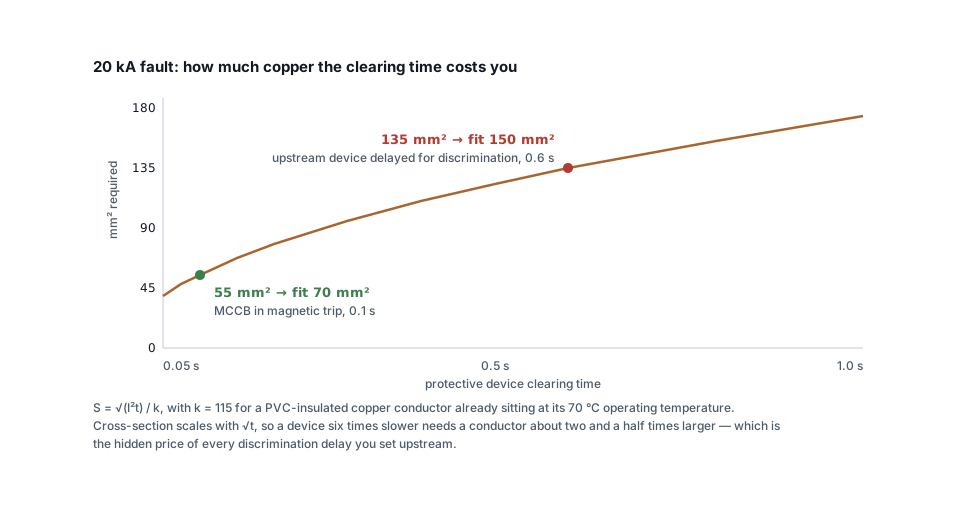
A cable that passes current rating and volt drop can still fail under fault. The adiabatic check, the right k value, and why discrimination delays cost copper.
7 min read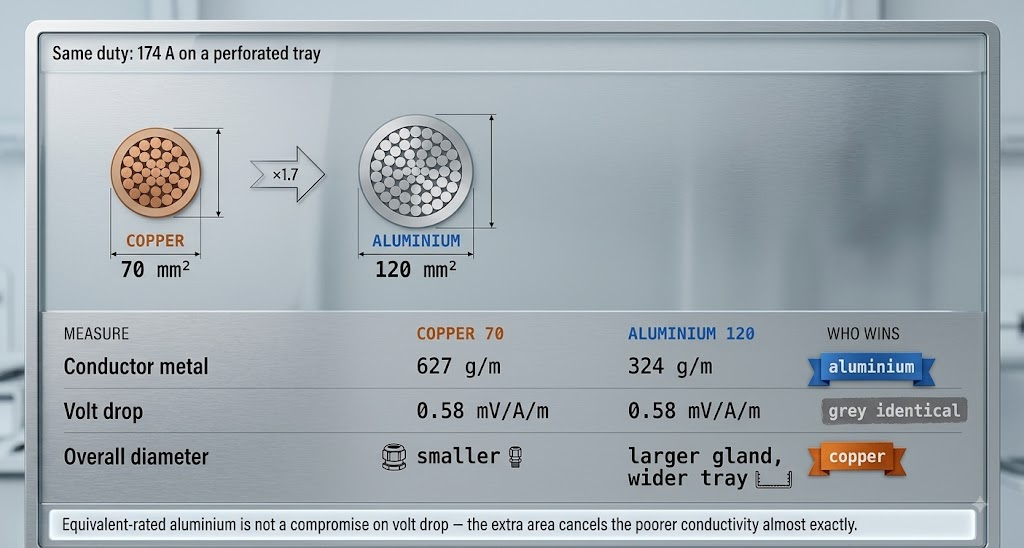 Cable sizing
Copper or aluminium: where aluminium stops being cheaper
Aluminium needs 1.6 times the cross-section for the same current — and still costs less per metre. The crossover, and the four places it goes wrong.
8 min read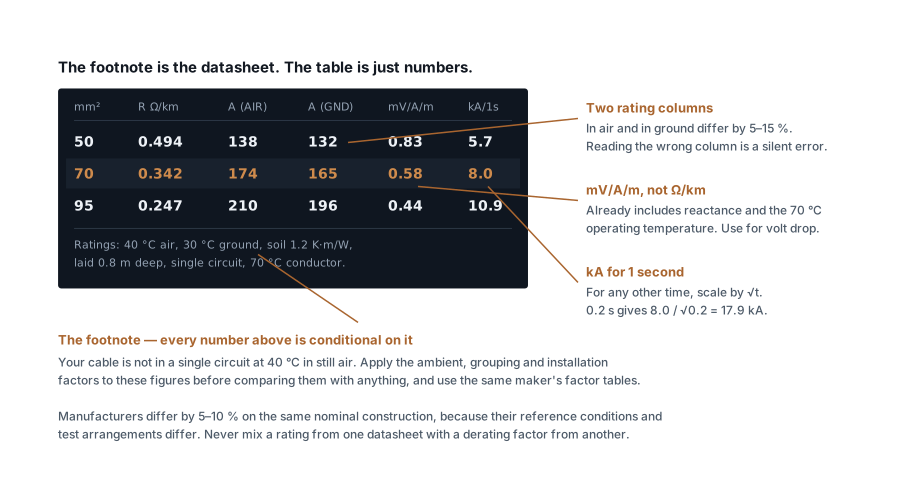 Cable sizing
How to read a cable datasheet without getting caught out
Reference conditions, two rating columns, mV/A/m versus ohms per km, one-second fault ratings and how to decode A2XFY — the fine print that decides the size.
7 min read Cable sizing
Cable derating factors: the complete table
Ambient, grouping and installation factors in one place, worked through — plus the four factors that are not in any table but still apply.
11 min read
Comments
Loading…