
The power factor penalty: what it costs, what fixing returns
Where reactive power comes from, how Indian tariffs charge for it, and a worked payback on a 200 kW plant — where the penalty is the smaller of the two savings.
Power factor is the only line on an industrial electricity bill that you can change with a single purchase and see the result the following month. It is also the one most often left alone for years, because the penalty is buried in the bill and nobody adds it up.
This is where the reactive power comes from, how the tariff charges you for it, and a worked payback — including the part that is usually larger than the penalty itself.
Where reactive power comes from
Any load with a magnetic field has to build that field up and collapse it every cycle. The energy sloshes back and forth between the supply and the load without doing any work. That is reactive power, measured in kVAr, and your cables, transformer and switchgear have to carry it just the same.
The usual sources, worst first:
| Source | Typical power factor |
|---|---|
| Induction motor at 25 % load | 0.4 – 0.5 |
| Induction motor at full load | 0.85 – 0.88 |
| Welding transformer | 0.4 – 0.6 |
| Distribution transformer, unloaded | very poor, but small |
| Fluorescent with magnetic ballast | 0.5 |
| Induction furnace | 0.7 – 0.8 |
| Resistive heating, incandescent | 1.0 |
The part-load line is the important one. A motor's nameplate power factor is its figure at full load. The same motor running at a quarter of its rating can sit near 0.5. Plants full of oversized motors — and most plants are — have a poor power factor for that reason alone, and no amount of capacitor switching addresses the underlying waste.
How the tariff charges you
Almost every Indian industrial and commercial tariff does two things at once, and they are frequently confused:
1. Demand is billed in kVA, not kW. This is the big one. The demand charge — a fixed monthly amount per kVA of contract or recorded demand — is levied on apparent power. Poor power factor inflates the kVA for the same useful work, so you pay more every month without consuming anything extra.
2. A power factor penalty or incentive on top. Typically a penalty below 0.90 that grows as the power factor falls, a neutral band, and a rebate above 0.95. Some states also penalise leading power factor.
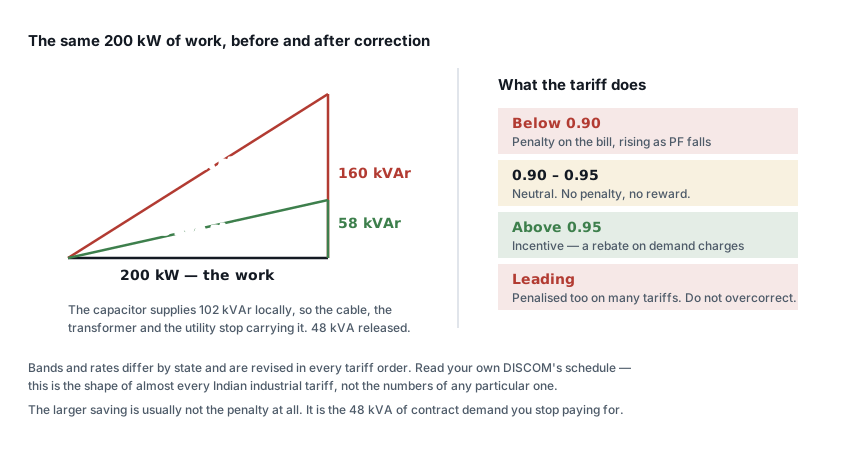
The rates, the bands and the formula differ by state and change with every tariff order. Read your own DISCOM's schedule — what follows is the shape, not the numbers of any particular utility.
Worked example: a 200 kW plant
A factory drawing 200 kW at a measured power factor of 0.78.
Apparent power now   = 200 / 0.78 = 256 kVA
Reactive power now   = 200 × tan(arccos 0.78) = 160 kVAr

Target 0.96:
Apparent power       = 200 / 0.96 = 208 kVA
Reactive power       = 200 × tan(arccos 0.96) = 58 kVAr

Capacitor required   = 160 − 58 = 102 kVAr
So a 100 kVAr bank, near enough, and the plant's apparent demand falls by 48 kVA. The kW, kVA and kVAr converter does this arithmetic for any load and target.
Now put money against it. Take a demand charge of ₹350 per kVA per month — check your own tariff, this varies widely — and ignore the penalty entirely for a moment:
Before:  256 kVA × ₹350 = ₹89,600 per month
After:   208 kVA × ₹350 = ₹72,800 per month
Saving:                   ₹16,800 per month = ₹2.02 lakh a year
Add the penalty that stops being levied, and the incentive that starts being paid, and the annual figure grows further. Against an installed cost of roughly ₹1.5–2.5 lakh for a 100 kVAr automatic panel, the payback is inside a year on the demand charge alone.
Notice which saving is bigger. Most discussion of power factor is about the penalty. The penalty is real, but the demand charge on 48 kVA of apparent power you no longer draw is usually the larger number — and it keeps paying every month whether or not the penalty band ever applied to you.
The savings nobody puts in the business case
Three more, all real, none of which appear on the bill as a line item:
Released capacity. Those 48 kVA are 48 kVA the transformer, the incomer and the cables no longer carry. On a plant that is close to its transformer rating, correcting power factor can defer buying a bigger transformer entirely — which is a capital saving an order of magnitude above the tariff saving. Check what it does to your loading with the transformer sizing calculator.
Lower losses. Cable and transformer copper loss goes with the square of current. Cutting current by 19 % cuts copper loss by about a third, every hour the plant runs.
Better voltage at the far end. Less current means less volt drop, which means motors at the end of long runs see closer to their rated voltage and run cooler.
Where to connect the capacitors
| Method | Corrects losses in | Best for |
|---|---|---|
| At the motor terminals | Everything upstream, including the final cable | Large motors that run continuously |
| At the distribution board | The submain and above | Groups of smaller motors |
| At the main incomer | Only the utility side | Removing the tariff penalty and nothing else |
Correcting at the incomer fixes the bill. Correcting at the load fixes the bill and the internal losses, and lets you use smaller cable on new circuits. Most plants end up with a mixture: fixed compensation on the large continuous motors, and a switched bank at the main board for everything else.
Two cautions on motor-terminal capacitors. Never connect a fixed capacitor on the motor side of a VFD or a soft starter — it will destroy the drive. And size motor-terminal capacitors below the motor's magnetising current, or the motor can self-excite when it is switched off while still spinning.
Do not chase unity
Correcting to 1.0 is a mistake, for three reasons:
- Beyond unity the power factor goes leading, and many tariffs penalise that exactly as they penalise lagging.
- A fixed bank sized for full load massively overcorrects at night and at weekends, when the plant load falls but the capacitors stay connected.
- Leading power factor causes voltage rise at light load and can resonate with system inductance.
Target 0.95 to 0.98 and use an automatic panel that switches steps in and out as the load varies. On a plant whose load swings — most plants — a fixed bank is the wrong answer even when the total kVAr is right.
Before you buy anything
- Get three bills. Recorded demand in kVA, average power factor, and any penalty or incentive line. That is your baseline and your business case.
- Log the load for a fortnight. A fixed bank suits a steady load; a varying load needs steps. The load profile decides which.
- Check for harmonics first. If the plant has significant VFD or rectifier load, plain capacitors can resonate with the supply and make things dramatically worse. That needs detuned reactors, and it is the subject of the APFC panel post.
- Size against a target, not against unity. Work the kVAr out with the power conversion calculator at a 0.95–0.98 target.
Related articles
More on power factor & power quality.
 Power factor & power quality
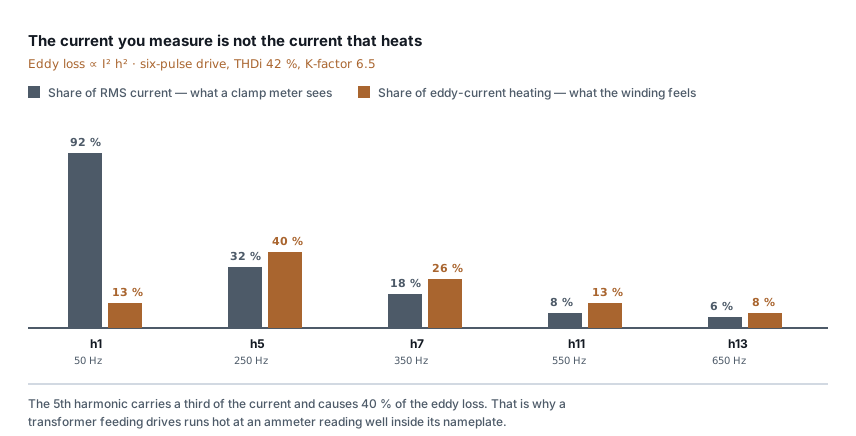
Transformer running hot: harmonics and K-factor
The ammeter reads 70 % of nameplate and the transformer is too hot to touch. Why eddy loss follows frequency squared, and what K-factor really tells you.
7 min read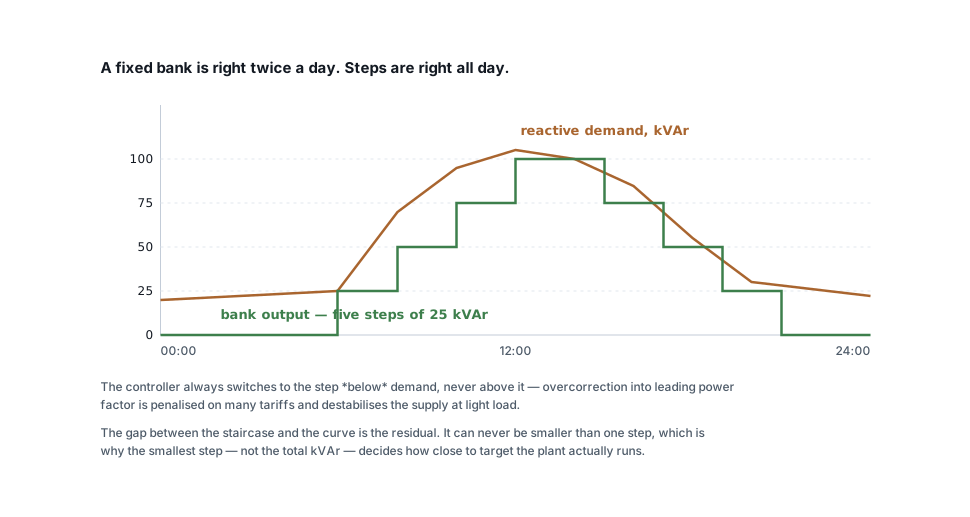 Power factor & power quality
APFC panels: sizing the steps, and avoiding resonance
How an automatic power factor panel decides what to switch, why the smallest step matters more than the total kVAr, and when you must fit detuned reactors.
6 min read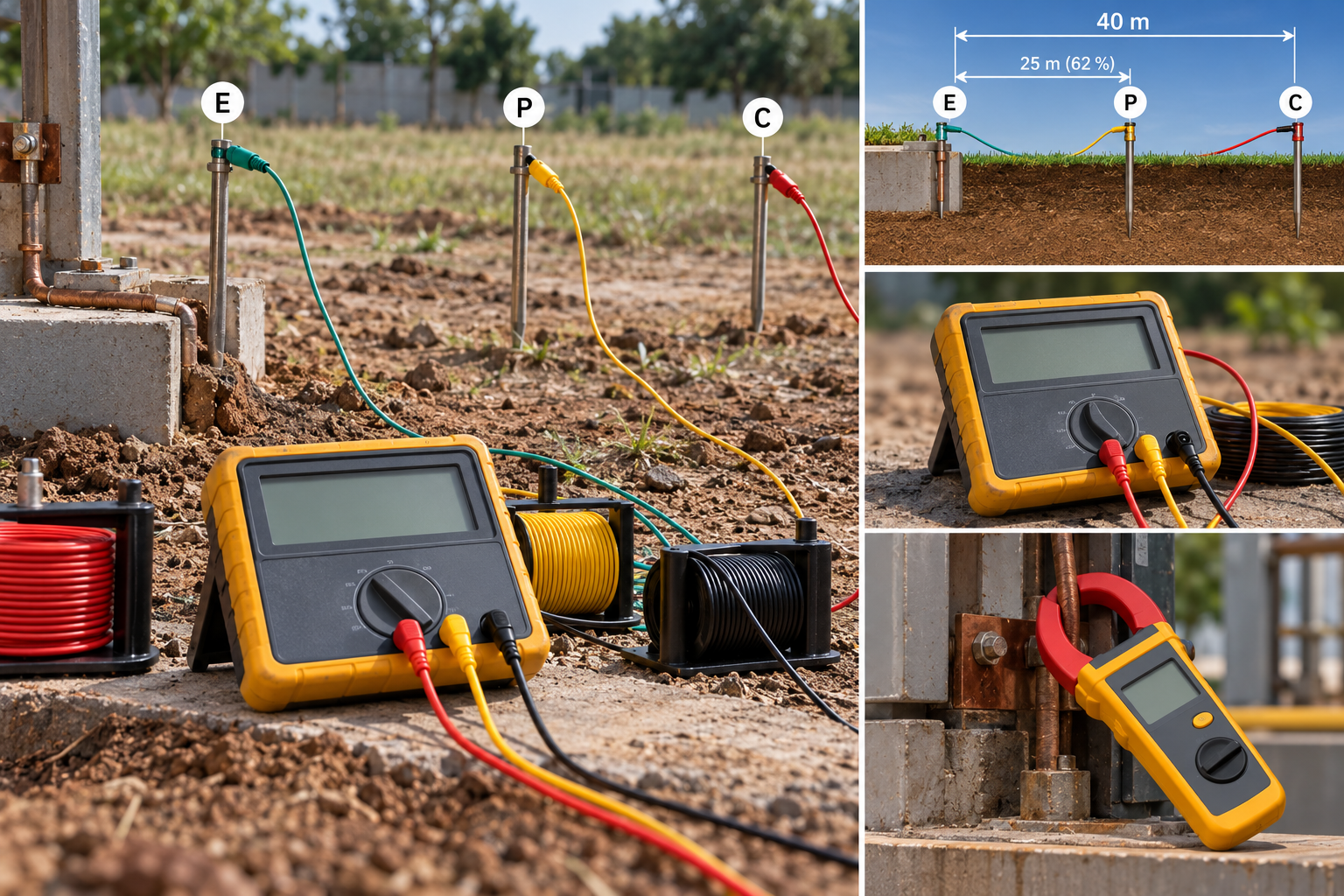 Panels, protection & earthing
Earth resistance testing: the 62 % rule, and when the clamp-on lies
Fall-of-potential done properly, the three-position check that proves it, IS 3043 limits by application, and when a clamp-on tester measures nothing.
8 min read Cable sizing
Cable size for large loads: when to run cables in parallel
Above 300 mm², a bigger cable size stops paying. When to run cables in parallel, the six rules for equal sharing, and the overload no breaker can see.
10 min read
Comments
Loading…