
Copper or aluminium: where aluminium stops being cheaper
Aluminium needs 1.6 times the cross-section for the same current — and still costs less per metre. The crossover, and the four places it goes wrong.
Every cable schedule of any size reaches this argument. Aluminium is a fraction of the price of copper per kilogram, so an aluminium cable should be cheaper. It usually is — but not always, and the size at which it stops being cheaper is higher than most people assume.
The honest answer is that aluminium wins on the big feeders and loses on the small circuits, and the crossover is not really about the metal price at all. It is about terminations.
Start with the physics
Aluminium conducts about 61 % as well as copper. To carry the same current at the same temperature rise you need roughly 1.6 times the cross-sectional area. Working from typical armoured cable tables:
| Copper | Rating | Nearest aluminium | Rating |
|---|---|---|---|
| 25 mm² | 92 A | 50 mm² | 108 A |
| 50 mm² | 138 A | 70 mm² | 136 A |
| 70 mm² | 174 A | 120 mm² | 190 A |
| 95 mm² | 210 A | 150 mm² | 218 A |
| 185 mm² | 318 A | 300 mm² | 339 A |
The jump is not free. That extra area means a fatter cable, a larger gland, a bigger termination, more tray width and a larger bending radius.
But here is the part that surprises people: it is still lighter. Aluminium is a third the density of copper, so even at 1.7 times the area an aluminium conductor weighs about half as much per metre. On long runs that changes how the cable is handled, what it costs to pull and what supports it needs.
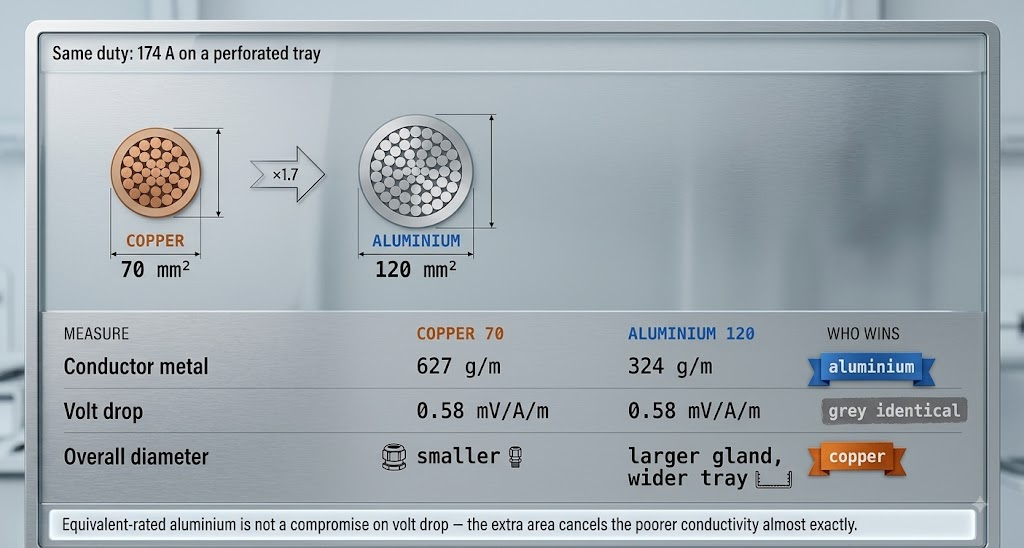
Volt drop is the pleasant surprise. Compare equivalent-rated sizes rather than equal areas and the mV/A/m figures land within a few per cent of each other. The extra cross-section aluminium needs for its current rating also fixes its resistance. Sizing by current and then checking volt drop, as in the cable sizing calculator, you will rarely find aluminium pushed up a size that copper was not.
Where aluminium clearly wins
Long runs of large cable. Submains, transformer-to-panel feeders, incoming services, the run to a distant pump house. Anything from about 95 mm² copper equivalent upwards, over any real distance, and the metal saving dwarfs everything else.
Overhead and outdoor distribution. Weight per metre governs pole spacing and sag. This is why the DISCOM's network outside your gate is aluminium and always has been.
Anywhere theft is a risk. Copper on an open site walks. Aluminium is worth too little to be worth cutting down.
Where aluminium loses
Final circuits and small sizes. Below about 25 mm² the metal saving is trivial in absolute terms, and everything else about aluminium gets harder. Small aluminium conductors are mechanically fragile, they do not tolerate repeated bending at terminations, and the accessories often are not rated for them.
Anywhere with many terminations. This is the real crossover, and it is a labour question, not a metal question. Every aluminium termination needs to be done properly — and "properly" means more steps than copper:
- The oxide layer must be wire-brushed off and joint compound applied immediately. Aluminium re-oxidises in minutes, and aluminium oxide is an insulator.
- The lug must be rated for aluminium, or bimetallic where it meets a copper busbar. An aluminium conductor bolted directly to copper in a damp panel is a galvanic cell, and it corrodes.
- The joint must be torqued to specification, with Belleville washers, and re-torqued after the first thermal cycles. Aluminium creeps under sustained pressure; a joint that was tight on commissioning day can be loose in a year.
A feeder with two terminations amortises that effort over a hundred metres. A distribution board with forty outgoing ways does not.
Tight spaces. If the cable has to fit an existing tray, duct, gland plate or bending radius, the 1.7× area can simply make aluminium impossible. Retrofits inside an existing containment are frequently a copper job regardless of price.
The comparison people get wrong
Comparing a copper cable and an aluminium cable of the same size — 70 mm² copper against 70 mm² aluminium. That comparison is meaningless: they do not carry the same current, so they are not alternatives for the same circuit.
The valid comparison is between two cables that do the same job. Price a 120 mm² aluminium cable against a 70 mm² copper cable, both delivered, both with their glands, lugs and labour, and both derated for the same installation conditions. Anything else is comparing two different circuits.
Do the same on the total installed cost, not the cable price:
| Include | Because |
|---|---|
| Cable, per metre delivered | The obvious one |
| Glands and lugs | Aluminium needs larger, and often bimetallic |
| Termination labour | The hidden cost — bigger for aluminium |
| Tray or duct width | The extra area has to go somewhere |
| Handling and pulling | Aluminium is lighter — a genuine saving on long runs |
| Re-torquing at first maintenance | A real cost, and skipping it is a fire risk |
What about the losses?
Since the two options are sized to the same current rating, their resistance per metre is similar, and so is their energy loss. This is one comparison that is usually a wash.
It is worth checking on a heavily loaded, continuously running feeder though. If aluminium lands you just above the required rating while copper lands you comfortably above it, the copper option may run cooler and lose less. Work out the loss in kWh a year and price it — on a feeder running 8,000 hours it can be a larger number than the cable price difference.
Not all aluminium is the same aluminium
The aluminium in a modern cable is usually not the pure EC-grade metal that gave aluminium wiring its reputation in the 1970s. Building-wire aluminium is now typically an 8000-series alloy, developed specifically to fix the failure mode that caused the trouble.
The original problem was creep. Pure aluminium under sustained clamping pressure flows away from the load, so a joint tightened correctly on commissioning day loosens by itself, heats, oxidises and eventually fails. 8000-series alloy has far better creep and elongation behaviour, and modern connectors are designed and tested around it.
This matters when you are reading old advice. "Aluminium terminations are unreliable" was true of a particular metal in particular connectors, and it is why the practices in the previous section exist — but a properly made termination on 8000-series conductor into an AL-rated lug, torqued to specification with Belleville washers, is a joint you can expect to last.
What has not changed is that it is unforgiving of shortcuts. Copper tolerates a sloppy termination for years. Aluminium does not.
Why the price you were quoted moves
Both metals trade on the London Metal Exchange, and the conductor is a large share of a cable's cost — larger for copper, which is why copper quotations go stale faster.
Three consequences worth planning for:
- Quotations have a validity period for a reason. On a long procurement, the copper price at order can differ materially from the price at tender.
- The crossover moves. The point at which aluminium becomes the cheaper installed answer shifts with the metal ratio, so a rule that held on last year's project may not hold on this one. Reprice, do not assume.
- Aluminium is more stable in absolute terms simply because there is less money in the metal. On a large fixed-price contract, that predictability is worth something on its own, separately from the headline saving.
A working rule
| Situation | Choose |
|---|---|
| Under 25 mm² equivalent | Copper |
| Final circuits, socket outlets, control | Copper |
| Many terminations per metre of run | Copper |
| Submains and feeders over 50 mm² equivalent | Aluminium, usually |
| Long runs, few terminations | Aluminium |
| Retrofit into existing containment | Whatever fits — usually copper |
| Outdoor, overhead, theft-prone | Aluminium |
There is no single crossover size, because it depends on your labour cost and the metal price on the day you buy. What does not change is the shape of the decision: the metal saving scales with length, and the extra cost scales with the number of terminations. Divide one by the other and the answer usually becomes obvious without a spreadsheet.
Size the circuit first, in copper and in aluminium, with the derating and volt drop that apply to your route — the cable sizing calculator will do both — then price the two complete installations. Deciding on metal price alone is how a job ends up with forty aluminium terminations in a distribution board and an electrician who will remember you.
Related articles
More on cable sizing.
 Cable sizing
Cable size for large loads: when to run cables in parallel
Above 300 mm², a bigger cable size stops paying. When to run cables in parallel, the six rules for equal sharing, and the overload no breaker can see.
10 min read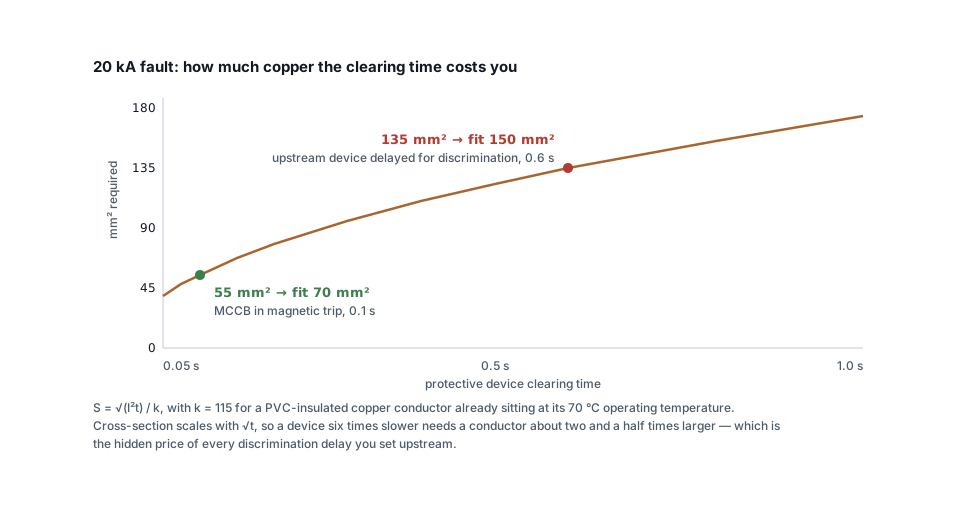 Cable sizing
Short-circuit withstand: the cable check everyone skips
A cable that passes current rating and volt drop can still fail under fault. The adiabatic check, the right k value, and why discrimination delays cost copper.
7 min read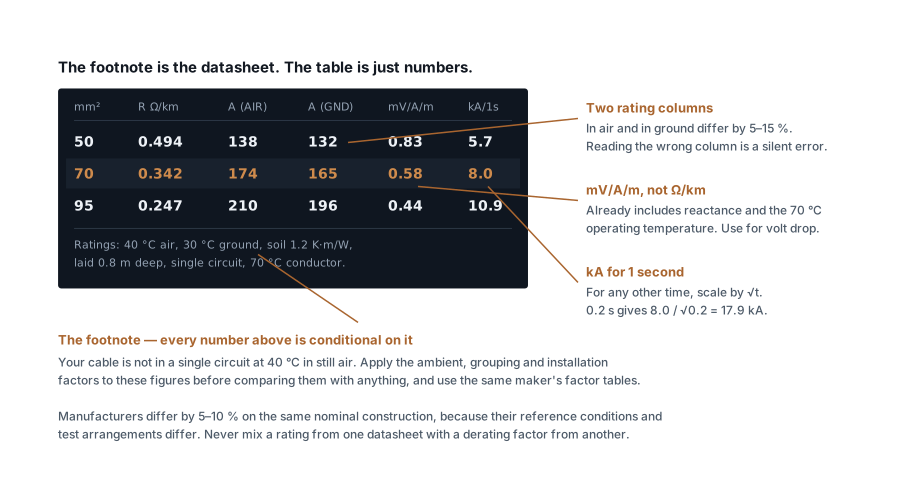 Cable sizing
How to read a cable datasheet without getting caught out
Reference conditions, two rating columns, mV/A/m versus ohms per km, one-second fault ratings and how to decode A2XFY — the fine print that decides the size.
7 min read Cable sizing
Cable derating factors: the complete table
Ambient, grouping and installation factors in one place, worked through — plus the four factors that are not in any table but still apply.
11 min read
Comments
Loading…