
MCCB keeps tripping: how to find out why
Time the trip first — it halves the search. Then work through overload, short circuit, earth fault and the causes that are not faults at all.
A breaker that has tripped tells you almost nothing by itself. The handle is in the same place whether the cause was a slow overload building over twenty minutes or a dead short that cleared in eight milliseconds, and those two need completely different things done about them.
So before touching anything, get one piece of information: how long was it running before it went? That single answer eliminates most of the list below.
Time the trip, and read the curve
A thermal-magnetic MCCB has two independent trip elements with completely different jobs.
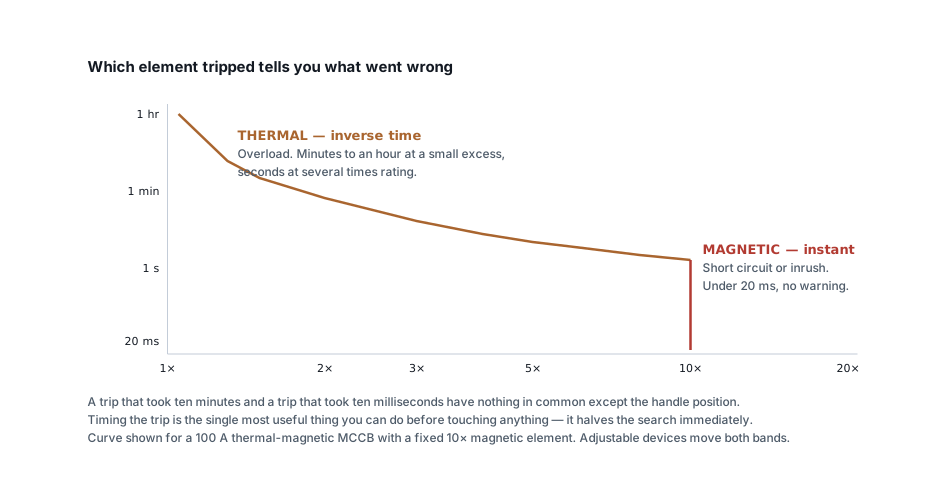
The thermal element is a bimetallic strip responding to heat. It takes minutes at a modest overload and seconds at several times rating. If the load ran normally for a while and then tripped, this is what operated, and you are looking for an overload — real or apparent.
The magnetic element is a solenoid with a fixed or adjustable pickup, often around 10 × In. It operates in under 20 ms. If the trip happened at the instant something switched on, this is what operated, and you are looking for a short circuit or an inrush.
Many MCCBs have a trip indicator or a separate earth-fault flag. Look before you reset — resetting destroys the evidence.
If it took minutes: the overload family
The load has genuinely grown. The commonest cause and the least interesting. Clamp each phase under normal running and compare against the setting. Plant accumulates load — a compressor added, a heater fitted, a motor replaced with a larger one — and nobody revisits the breaker.
The setting is wrong for the cable, not the load. On a motor circuit the overload relay in the starter protects the motor; the breaker upstream is doing short-circuit duty. Confusing the two is how a breaker ends up set at the motor's full load current, tripping on every long run-up. Check what each device is actually protecting with the breaker sizing calculator.
The panel is hot. Thermal elements are calibrated at a reference ambient — 30 °C for MCBs to IEC 60898, 40 °C for MCCBs to IEC 60947-2 — and derate above it. A 100 A MCCB in a 55 °C panel is closer to an 85 A device. The tell is seasonal: it trips in May and behaves in December. Fix the ventilation, not the breaker.
Phase imbalance. A three-phase breaker trips on whichever pole sees the excess. Single-phase loads unevenly distributed across phases can put one pole 20 % above the others while the total looks fine. Clamp all three.
Harmonics, on a device that reads true RMS. Distorted current has a higher RMS value than its fundamental, and a plant full of drives can run a breaker above its rating while a cheap clamp meter reading average-responding says otherwise. The harmonic loss calculator converts a measured spectrum into the real RMS current.
A loose connection. A terminal that is not tight runs hot, and that heat conducts into the breaker's thermal element. The breaker trips because it believes it is overloaded, and it half is. Thermal-image the panel at load, or at minimum check terminal temperatures by hand after a run. This one also gets worse over time, which makes it look like a slowly growing load.
If it went instantly: the short-circuit family
A genuine fault. Megger the circuit with the load disconnected before assuming anything else. A cable damaged by a screw, a motor with a winding failure, water in a junction box.
Inrush the breaker was never meant to pass. Transformers, capacitor banks, LED driver arrays and DOL motors all draw a surge far above running current for a few cycles. If the trip happens only at switch-on and never during running, this is it. The fix is the curve, not the rating: a C-curve device trips magnetically at 5–10 × In, a D-curve at 10–20 ×. Motors usually want D, or better, an MPCB whose magnetic element sits around 13 × In with a thermal element set to the motor.
Capacitor switching. An APFC step energising onto an already-charged capacitor draws an enormous transient. If the trip correlates with the bank switching rather than with production, look at the discharge resistors and the contactor type — capacitor duty contactors exist precisely for this.
Cumulative starts. A motor started repeatedly does not let the thermal element cool between attempts. Each start is survivable and the fourth in five minutes is not. Class 10 relays trip in 10 s at 6 × setting; frequent starting needs class 20 or 30.
If the earth-fault flag is up
That is a different fault entirely and none of the above applies. Insulation breakdown, moisture, a damaged cable, or a VFD leaking common-mode current to earth through its filter capacitors — the last one is a common cause of apparently random trips on drive circuits, and it needs a Type B residual device, not a smaller setting.
What not to do
Do not fit a larger breaker. If the cable was sized for the original device,
a larger one no longer protects it — the cable can then sit above its rating
indefinitely with nothing tripping. Ib ≤ In ≤ Iz is the rule, and the Iz is
the cable's capacity after derating, not the table figure.
Do not raise the setting to make it stop. Same problem, no paperwork.
Do not reset repeatedly into a fault. Each operation on a fault erodes the contacts, and a breaker that has interrupted near its Icu may no longer be fit for service — which is what the separate Ics rating exists to describe.
Quick reference
| What you saw | Element | Look at first |
|---|---|---|
| Ran fine for 20 min, then went | Thermal | Load growth, panel ambient, loose terminal |
| Trips only in summer | Thermal | Ambient derating — 100 A at 55 °C is nearer 85 A |
| Went the instant something started | Magnetic | Inrush, wrong trip curve, DOL motor |
| Went with a bang or a smell | Magnetic | Genuine fault — do not reset, inspect |
| Trips on the fourth start in five minutes | Thermal | Cumulative starting, relay class too low |
| Random, on a drive circuit | Earth fault | Common-mode leakage — needs a Type B RCD |
| Gets steadily worse over months | Thermal | Loose connection heating the element |
| One phase warm, others cool | Thermal | Imbalance across single-phase loads |
The last two are the ones people chase hardest, because neither looks like a fault on a meter. A joint that has loosened conducts its own heat into the breaker, so the device trips believing it is overloaded — and it half is.
A sequence that works
- Read the indicator before resetting. Thermal, magnetic or earth fault.
- Time it. Minutes, or instant?
- Clamp all three phases under normal running, and compare with the setting and with each other.
- Take the panel's internal temperature, not the room's.
- Check terminal torque on that breaker and its cable.
- Correlate with events — does it coincide with a motor start, a capacitor step, a shift change?
- Megger the circuit if it is instantaneous and no inrush explains it.
- Only then look at the device selection: rating, curve, and whether the cable supports the change.
If step 3 shows the load genuinely exceeds the design, the answer is a bigger cable and a bigger breaker, in that order — and everything downstream needs rechecking, including fault level and the busbar it lands on.
When to stop and call someone
A trip you cannot explain after the sequence above is a reason to stop resetting. So is any trip accompanied by a bang, a smell, or discoloured terminals — that is arc damage, and the breaker and its terminations need inspecting before the circuit is re-energised. Repeated earth-fault trips on a circuit people can touch are not something to live with while you investigate.
Standards referenced
- IEC 60898 — Electrical accessories — Circuit-breakers for overcurrent protection for household and similar installations. International Electrotechnical Commission
- IEC 60947-2 — Low-voltage switchgear and controlgear — Part 2: Circuit-breakers. International Electrotechnical Commission
Titles are given as commonly published. Check the current edition with the publisher before relying on a clause in professional work.
Related articles
More on troubleshooting.
 Troubleshooting
Insulation resistance test values: what passes, and when to reject
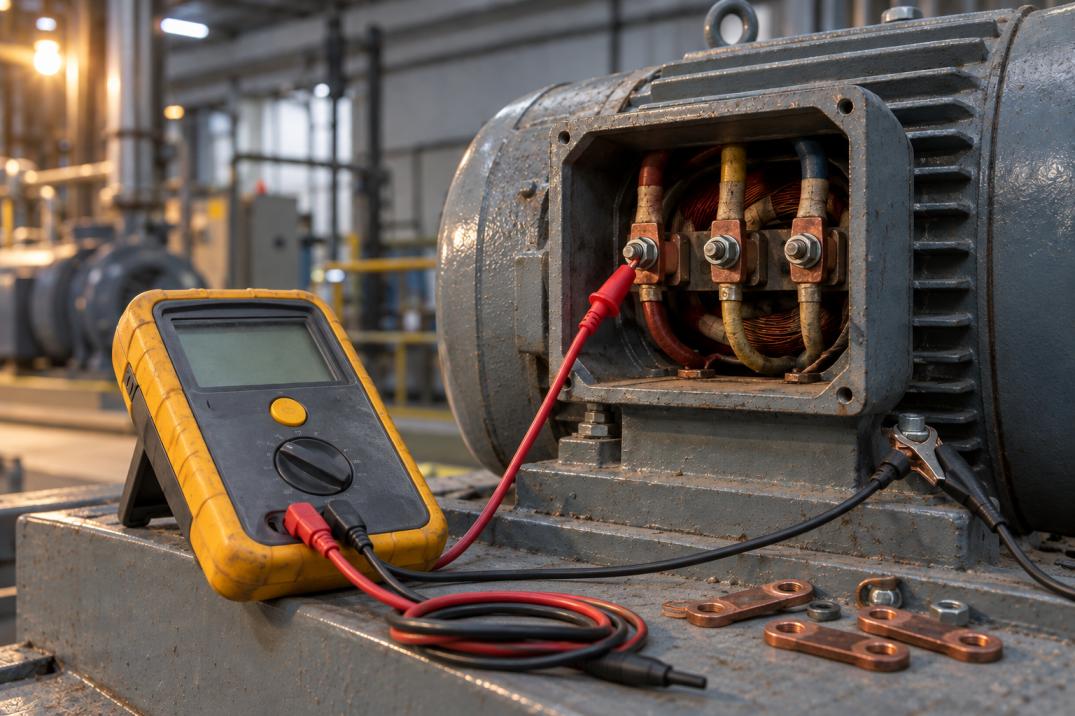
What a megger reading means: IS 732 and IEEE 43 limits, temperature correction, polarisation index, and the three things that fake a failure.
13 min read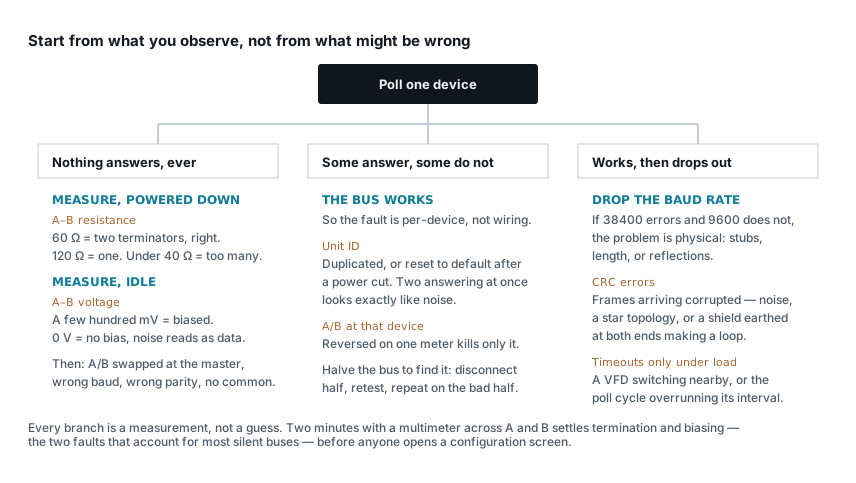 Troubleshooting
Modbus RTU not responding: a diagnostic sequence
Timeouts, CRC errors and silent devices, worked from what you can observe. Two minutes with a multimeter settles the two commonest causes.
7 min read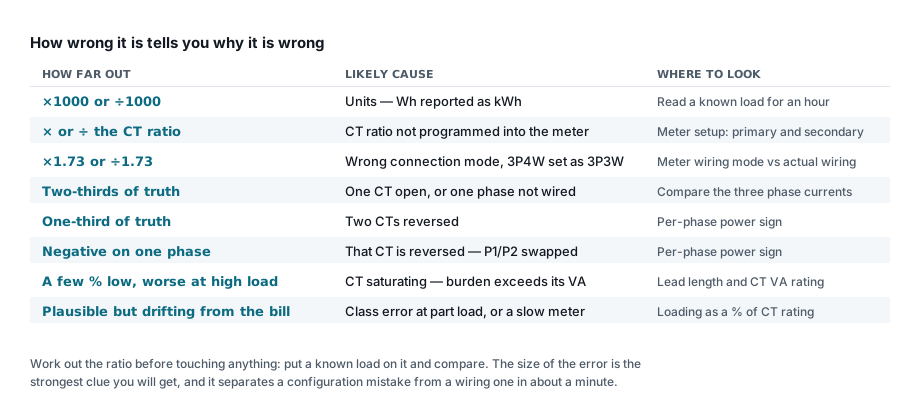 Troubleshooting
Energy meter showing wrong readings: a checklist
Work out how wrong it is first — the size of the error names the cause. Ratio errors, reversed CTs, saturation and the ones that look plausible.
7 min read Troubleshooting
Power factor still poor after fitting capacitors: why
The bank is installed, the contactors click, and the bill has not moved. Six causes, ranked, and the one clamp-meter test that finds most of them.
7 min read
Comments
Loading…