
Energy meter showing wrong readings: a checklist
Work out how wrong it is first — the size of the error names the cause. Ratio errors, reversed CTs, saturation and the ones that look plausible.
A meter reading that is obviously absurd is easy. A meter reading that is plausible and wrong is the expensive one, because it gets believed, billed on, and used to justify decisions for months before anyone reconciles it against the utility bill.
Either way the method is the same, and it starts before you touch a single terminal: work out how wrong it is. Put a known load on the circuit, compare, and get a ratio. That number names the cause faster than any amount of inspection.
The error tells you the fault
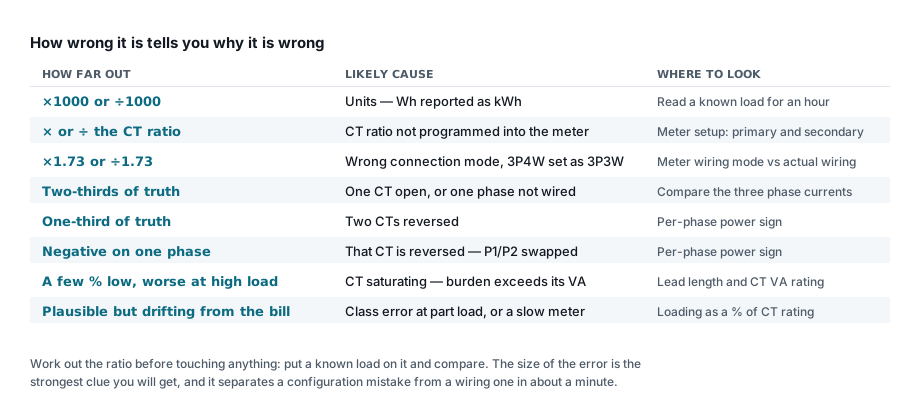
The distinction that saves the most time: configuration errors give clean round multiples, wiring errors give awkward ones. A factor of 1,000 or exactly the CT ratio is somebody's setup menu. A factor of 1.73, a missing third, or a negative sign is copper.
Factors of 1,000 and factors of the CT ratio
Units. Plenty of meters report energy in watt-hours, not kilowatt-hours, and a register map that does not say so produces a reading a thousand times too large. The same applies to current in milliamps and power in watts against kilowatts.
The CT ratio is not programmed. A CT-operated meter has to be told its primary and secondary. Left at a default of 5/5 with a 200/5 CT fitted, it reads forty times low — and forty is exactly the CT ratio, which is the tell. Check the meter's setup menu against the CT nameplate, not against the drawing.
Both at once. A factor of 40,000 is not a mystery, it is 1,000 × 40. Factor the error before assuming something exotic.
The awkward factors: wiring
A factor of √3 — 1.73 — means the connection mode is wrong. Three-phase meters can be configured for 3P4W (four-wire, with neutral) or 3P3W (three-wire, two-element measurement). Wire one way, configure the other, and the meter applies the wrong maths. This is the single most common commissioning error on three-phase metering, and it is invisible unless you know to look for the number.
Two-thirds of the truth means one of three elements is contributing nothing: a CT with an open secondary, a voltage input not connected, or a phase simply not wired. Compare the three per-phase currents — one reading zero or wildly different names the phase.
One phase showing negative power is a reversed CT, P1 and P2 swapped. On the three-phase total this is not obvious, because one phase subtracts instead of adding: the total comes out around a third low rather than obviously broken. Any meter with per-phase registers makes this trivial to spot, which is one of the better arguments for buying one that has them.
Reversed voltage phase rotation is rarer and produces power factor readings that make no sense — leading when the plant is inductive, or wildly different between phases.
The ones that look plausible
These are the dangerous set, because nothing on the display looks wrong.
CT saturation. If the burden exceeds the CT's VA rating, the core saturates and the output falls below the ratio. The error is small at light load and grows with current, so the meter reads low exactly when the energy matters, and every reading looks believable. Lead resistance is usually the culprit, not the meter — on a 5 A secondary the cable is most of the burden. Work it out with the CT ratio and burden calculator.
Class error at part load. A plain class 0.5 CT is only specified from 20 % of its rating upward; the S-class version holds to 1 %. A plant that idles overnight spends a large share of the year outside the specified range, and those hours accumulate quietly into the monthly total. The metering accuracy calculator puts a number on it.
An oversized CT ratio causes the same thing by a different route — a 1000/5 CT on a 150 A circuit runs at 15 % and is out of range most of the time.
Harmonics. Meter designs differ in how they handle distorted current, and a plant full of drives can push readings apart between two meters that are both working correctly. If a submeter and the utility meter disagree on a drive-heavy supply, measure the distortion before assuming one is faulty.
If the values are nonsense rather than wrong
Garbage rather than a wrong number — huge exponents, negative energy, values that jump — is a decoding problem, not a metering one. The bus is fine and the meter is fine; the interpretation is wrong. Byte and word order, data type and register offset are covered in Modbus RTU on energy meters, and the float decoder settles the byte order in seconds.
Making a load you can actually trust
Everything above depends on knowing the true consumption, and "the plant" is not a known load. Three ways to get one, in order of how much you can rely on them:
A resistive load of known rating. A bank of heaters, a load bank, even a set of incandescent lamps. Resistive means unity power factor and no harmonics, so the meter has the easiest possible job — if it is wrong on this, it is wrong. Run it for a measured hour and compare the energy register difference.
A clamp meter on the primary. Compare instantaneous current per phase against what the meter reports for that phase. This catches ratio and wiring errors immediately and needs no outage. It will not catch an energy register scaling error, because you are comparing current rather than energy.
The utility meter itself. Where the submeter is close to the incomer and little else is connected between them, the DISCOM meter is a calibrated reference somebody else pays to maintain. Read both at the start and end of a period and compare the difference, not the totals.
When the submeters disagree with the bill
Add up your submeters over a month and compare against the utility meter. The gap is unaccounted energy, and its behaviour tells you what it is:
- Small and stable — normal. Losses in cable and transformer, plus accumulated class error. A few per cent is expected.
- Large and stable — a genuinely unmetered load. Something is connected upstream of your metering that nobody has on the list.
- Growing month on month — drift, or a CT beginning to saturate as load rises. This is the one worth chasing early.
- Negative — your submeters total more than the main meter, which is arithmetically impossible and means a CT ratio entered wrongly or a feeder counted twice.
Do this monthly. It is the only check that tells you whether any of the other numbers can be trusted, and it takes ten minutes.
The checklist
- Quantify the error. Known load, compare, get a ratio. Everything else follows from it.
- Factor it. Is it 1,000, the CT ratio, √3, two-thirds, or none of those?
- Read the per-phase registers. Currents, powers and power factors, individually. One odd phase locates the fault immediately.
- Check the meter's own configuration — CT primary and secondary, PT ratio if any, connection mode, units.
- Clamp the primary and compare with what the meter reports for that phase.
- Check the burden — lead length and size against the CT's VA.
- Check the loading as a percentage of CT rating, at the time you are measuring.
- Reconcile monthly. Submeters against the main meter. A gap that grows is drift or saturation; a gap that appeared suddenly is a wiring change.
Before you condemn the meter
Meters are rarely the faulty component. In order of how often they are actually the cause: configuration, CT wiring, CT burden, CT class, decoding — and then the meter itself.
Two safety points while you are in there. Never open-circuit an energised CT secondary — short it first, which is what the links on a test block are for. And a meter that reads correctly on one phase and not another is telling you about the wiring, not asking to be replaced.
Related articles
More on troubleshooting.
 Troubleshooting
Insulation resistance test values: what passes, and when to reject
What a megger reading means: IS 732 and IEEE 43 limits, temperature correction, polarisation index, and the three things that fake a failure.
13 min read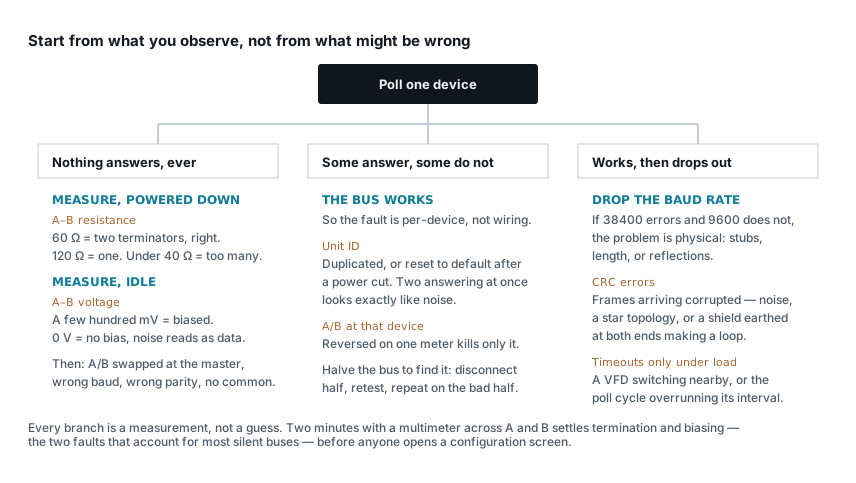 Troubleshooting
Modbus RTU not responding: a diagnostic sequence
Timeouts, CRC errors and silent devices, worked from what you can observe. Two minutes with a multimeter settles the two commonest causes.
7 min read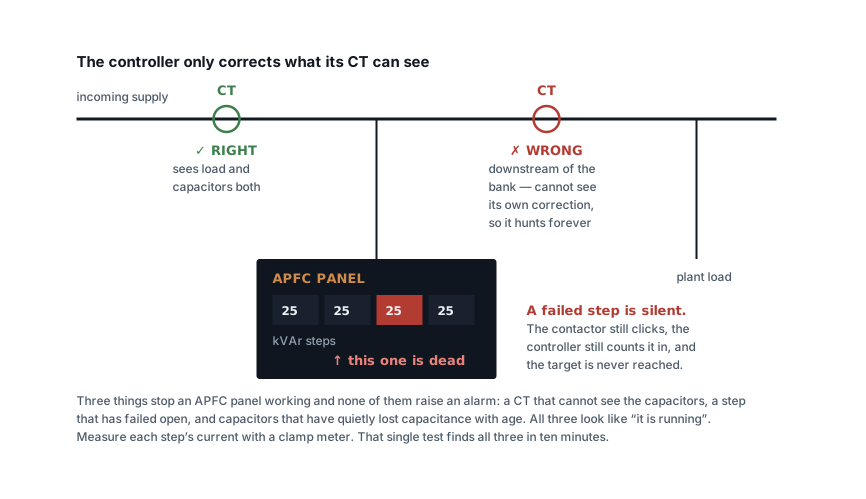 Troubleshooting
Power factor still poor after fitting capacitors: why
The bank is installed, the contactors click, and the bill has not moved. Six causes, ranked, and the one clamp-meter test that finds most of them.
7 min read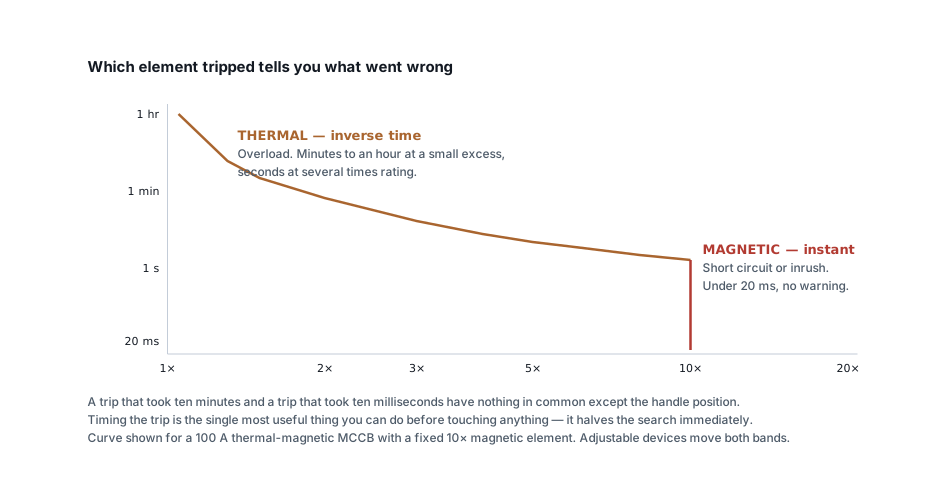 Troubleshooting
MCCB keeps tripping: how to find out why
Time the trip first — it halves the search. Then work through overload, short circuit, earth fault and the causes that are not faults at all.
7 min read
Comments
Loading…