
MQTT, Modbus TCP or HTTP: moving meter data to a server
Poll versus publish, what each protocol costs in bandwidth and firewall holes, how to design topics and payloads, and where each one genuinely belongs.
Once a gateway is reading meters reliably, the next question is how the data gets to wherever it is going to live. Three answers dominate, and they are not really competing — they belong at different points in the same system.
The distinction that matters is not the wire format. It is who starts the conversation, because that decides your firewall rules, your bandwidth, and what happens when the link drops.
Poll versus publish
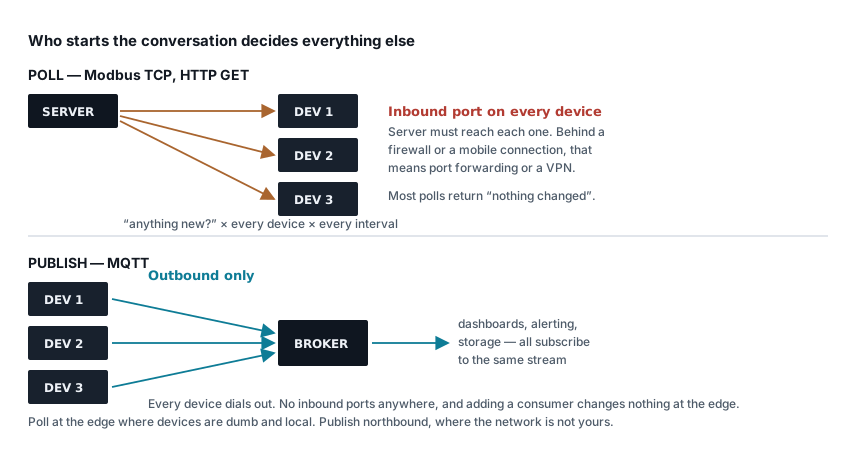
Polling — Modbus TCP, HTTP GET — means a server asks each device for data on a schedule. The server needs to reach every device, which means every device needs a reachable address and an open inbound port. Most polls return data that has not changed.
Publishing — MQTT — means each device connects outward to a broker and pushes data when it has some. Nothing needs an inbound port. Consumers subscribe to the broker, and adding a new consumer changes nothing at the edge.
The three options compared
| Modbus TCP | MQTT | HTTP / REST | |
|---|---|---|---|
| Model | Poll | Publish / subscribe | Poll or push |
| Overhead per reading | Very low | Low (2-byte minimum header) | High (headers, often more than the payload) |
| Direction | Inbound to device | Outbound from device | Either |
| Works behind NAT / mobile | Poorly | Yes | Yes, if pushing |
| Security | None built in | TLS, per-client credentials | TLS, tokens |
| Knows a device died | No — a timeout is ambiguous | Yes — last will and testament | No |
| Buffers on reconnect | No | With QoS 1 and persistent sessions | Only if you build it |
| Best at | The field bus, over existing Ethernet | Everything northbound | Occasional bulk transfer, integrations |
Modbus TCP is Modbus RTU's data model over Ethernet. It is the right choice where structured cabling already exists and the devices are on a network you control — it is fast, simple and every SCADA package speaks it. It has no authentication and no encryption whatsoever, which is fine on an isolated OT VLAN and unacceptable anywhere else. Never expose it to the internet.
MQTT is the default for anything leaving the site. It is designed for unreliable links and small messages, it needs no inbound ports, and it has two features that are worth the switch on their own:
- Last will and testament. The client registers a message when it connects, and the broker publishes it if the connection dies. Your monitoring system learns a gateway is gone within seconds, instead of inferring it from silence.
- Persistent sessions with QoS 1. The broker holds messages for a disconnected subscriber and delivers them on reconnect.
HTTP is the right answer for what it is good at: batch uploads, integrating with somebody else's API, or a low-rate system where the operational simplicity of "just POST some JSON" is worth the overhead. Sending one reading per second over HTTPS means a TLS handshake and several hundred bytes of headers to carry twenty bytes of data.
Getting MQTT right
Topic structure. Hierarchical, specific to general on the left, one device per branch:
site/plant1/shed2/mcc3/compressor-1/telemetry
site/plant1/shed2/mcc3/compressor-1/status
Rules that save pain later:
- No wildcards or variable depth. Subscribers use
+and#, so a consistent depth is what makessite/plant1/+/+/+/telemetrywork. - Never put data in the topic.
.../current/47.2cannot be subscribed to usefully. - Separate telemetry from status. Different rates, different retention, different consumers.
- Identify by role, not by hardware, for the same reason as in the gateway post — replacing a meter should not break a topic.
Payload. JSON is the sensible default: readable, debuggable, universally supported. Include the timestamp in every message, in UTC, generated at the edge.
{
  "ts": "2026-08-31T09:15:00Z",
  "kwh_import": 148237.4,
  "kw": 61.2,
  "pf": 0.91,
  "i": [88.4, 91.2, 87.9]
}
Send one message per device per interval with all its quantities, not one message per quantity. Twenty meters × 40 registers as individual messages is 800 messages a cycle, and each carries its own overhead.
QoS. QoS 0 for high-rate telemetry where the next reading is along shortly. QoS 1 for anything you must not lose — energy totals, alarms, status changes. QoS 2 is rarely worth its round trips; design your consumers to be idempotent instead, which you need anyway.
Retained messages on status topics, so a newly connected dashboard immediately knows the current state rather than waiting for the next change.
If you want a standard rather than a house convention, Sparkplug B defines topic structure, payload encoding and birth/death certificates for industrial MQTT. It is more machinery than a twenty-meter site needs, and it is a genuinely good answer for a large estate with many vendors.
How much data is this, really?
Worth estimating before choosing a SIM plan, because the answer surprises people in both directions.
Twenty meters, forty quantities each, published once a minute as JSON:
~400 bytes per message × 20 meters × 60 min × 24 h = ~11 MB/day
                                                   = ~330 MB/month
Comfortable on any fixed line, and a real consideration on a metered mobile connection. If it needs to come down, the levers in order of effect are: publish less often (a minute is already far more often than energy analysis needs), publish only quantities that changed, drop JSON for a binary encoding, and enable MQTT 5 topic aliases so the topic string is not repeated on every message.
Note what is not on that list: reading fewer registers from the meter. Polling the field bus is free — it happens over your own RS485 cable. Read everything the meter offers, using contiguous register blocks worked out with the address converter, and decide separately what to publish northbound. Data you did not collect is gone forever; data you collected and chose not to send is still on the gateway.
Security, which is the actual differentiator
The protocol choice is largely a security choice, so be explicit:
- TLS everywhere, with certificate verification actually enabled — not disabled to make the demo work and then forgotten.
- Per-device credentials, so one compromised gateway can be revoked without touching the others.
- Broker-side ACLs limiting each client to publishing on its own topic branch. A gateway should not be able to publish as another site.
- Outbound connections only. No port forwarding, no inbound rules, ever.
- Segment the OT network. The gateway may talk to meters and to the broker. Nothing else needs to talk to the meters.
A sensible default architecture
For almost every site under a few hundred points:
- Modbus RTU over RS485 from meters to a local gateway. Cheap, robust, works over a kilometre, no network infrastructure required.
- Local buffering on the gateway, with edge timestamps.
- MQTT over TLS northbound to a broker, outbound only.
- Subscribers on the broker for storage, dashboards and alerting — each independent, each addable without touching the field.
That gives you one polling domain, at the edge, where polling is appropriate because the devices are dumb and the bus is local. Everything upstream is event-driven, firewall-friendly and survives an intermittent link.
The mistake to avoid is polling across the internet — a central server reaching into twenty sites over VPNs to read Modbus TCP. It works, it is what many systems do, and every one of those VPN tunnels is a thing that breaks at 2 a.m. and a hole into an OT network that has no authentication behind it.
Related articles
More on metering & iot.
 Metering & IoT
PROFIBUS and PROFINET: how each is wired, and what breaks
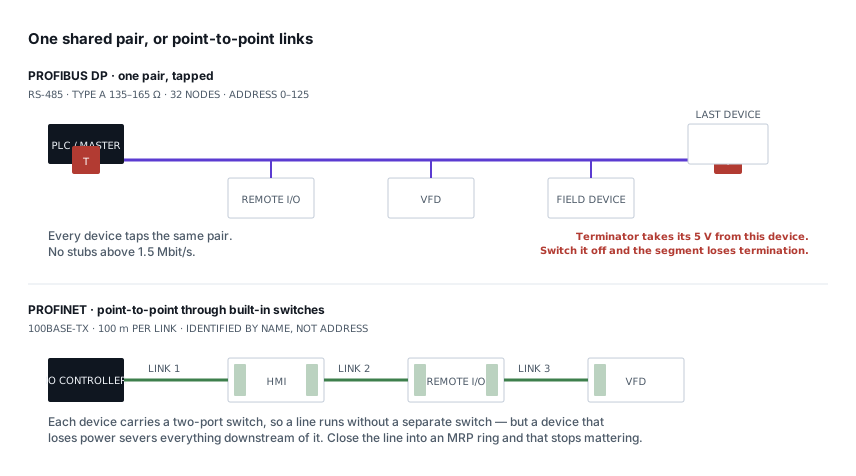
Purple cable at 150 Ω against green Ethernet, powered termination against none, device addresses against device names — and the fault each design invites.
8 min read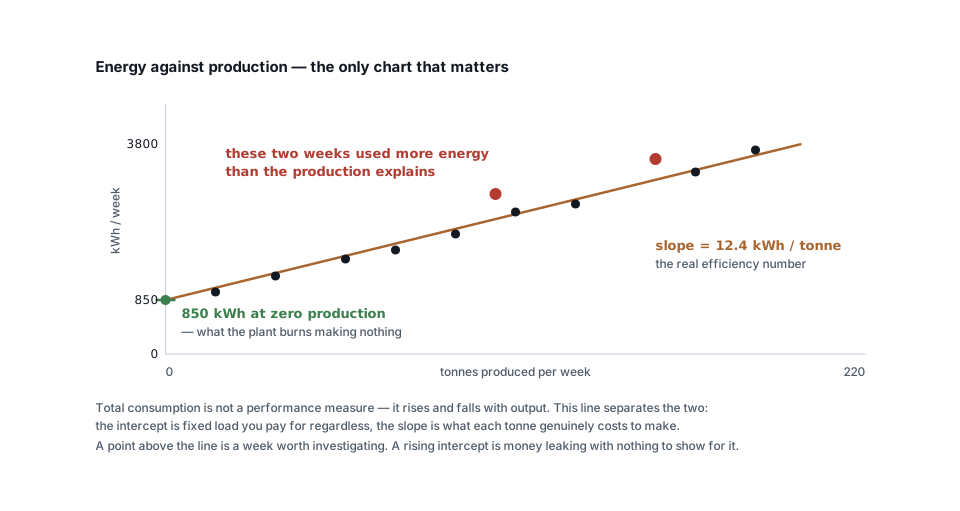 Metering & IoT
Turning meter data into savings: baselines, KPIs and alerts
Why total kWh is a useless measure, how to build an energy baseline against production, and the four analyses that actually find money in metering data.
6 min read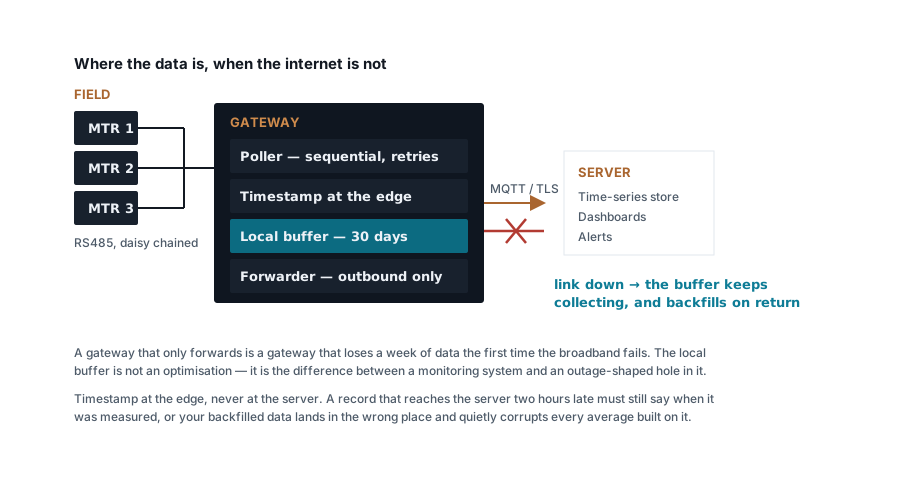 Metering & IoT
Building a Modbus energy monitoring gateway that stays up
Polling design, store-and-forward, timestamping at the edge, SD card wear and the naming convention you cannot change later — a field-grade gateway.
7 min read Metering & IoT
Choosing an RS485 to Modbus TCP gateway
Transparent tunnel or protocol gateway, multi-master handling, unit ID mapping and isolation — the specification that decides whether it works in year two.
7 min read
Comments
Loading…