
DOL, star–delta, soft starter or VFD: how to choose
Inrush is only half the decision. What each starter does to torque, which loads each suits, and the four failure modes that follow the wrong choice.
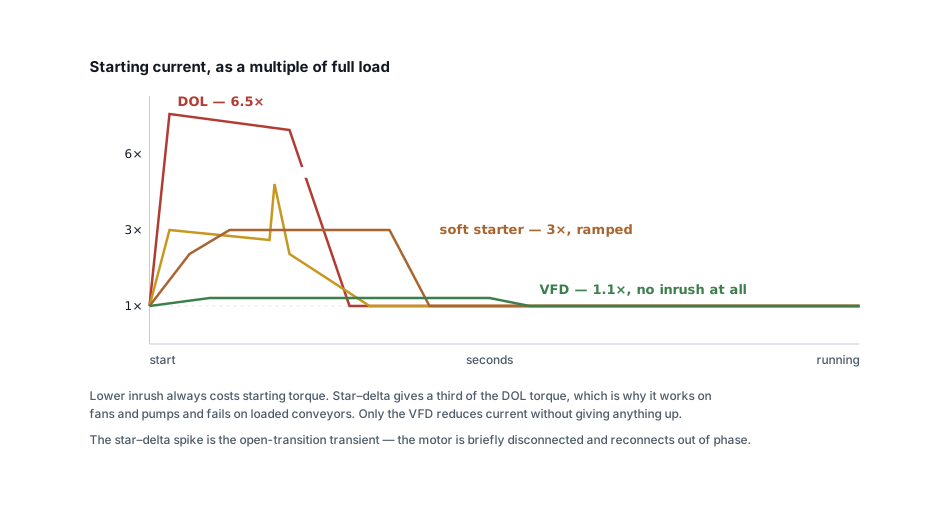
An induction motor switched straight onto the supply draws six to seven times its full load current for a few seconds. On a small motor nobody notices. On a large one it dips the voltage across the whole board, drops out contactors, annoys the DISCOM and — if the supply is a generator — can stall the set entirely.
Every starting method exists to reduce that inrush. Every one of them except a VFD reduces the starting torque at the same time, and that is the decision nobody makes carefully enough.
What each one does
| Method | Starting current | Starting torque | Relative cost |
|---|---|---|---|
| Direct on line | 6–7 × FLC | 100 % | 1 |
| Star–delta | 2–2.5 × FLC | 33 % | 2 |
| Soft starter | 3 × FLC (adjustable) | ~50 % | 4 |
| VFD | 1.1 × FLC | 150 %+ | 8–10 |
The torque column is the one to read first. Star–delta reduces current to a third because it reduces voltage per winding by √3 — and torque goes with the square of voltage, so it falls to a third as well. That is not a side effect; it is the same physics doing both.
Match it to the load, not the motor
What matters is the shape of the load's torque demand as speed rises:
| Load | Torque demand | Suitable starters |
|---|---|---|
| Centrifugal fan, centrifugal pump | Rises with speed² — very low at standstill | Anything, including star–delta |
| Compressor, unloaded | Low at start | Star–delta, soft starter |
| Compressor, loaded | High from standstill | DOL or VFD |
| Conveyor, loaded | Constant, high breakaway | DOL, soft starter (sized up), VFD |
| Crusher, mixer with material in | Very high breakaway | DOL or VFD |
| Positive displacement pump | Constant | Soft starter or VFD |
A star–delta starter on a loaded conveyor does not accelerate the load. The motor sits in star drawing locked rotor current, the overload relay eventually trips, and everyone blames the relay. The starter was never capable of the job.
The quick test: if the load cannot be started unloaded, star–delta is out.
Star–delta, and the transition nobody mentions
Star–delta is cheap, well understood and everywhere. Two things about it deserve more attention than they get.
Open transition. In the standard three-contactor arrangement the motor is briefly disconnected during the changeover from star to delta. It keeps spinning, its residual voltage drifts out of phase with the supply, and when the delta contactor closes the two can be opposing. The resulting current transient can exceed the DOL inrush the starter was fitted to avoid, along with a shock torque through the coupling and gearbox.
On anything with real inertia, use a closed transition starter — which adds resistors and a fourth contactor so the motor is never disconnected — or move to a soft starter.
The contactors are smaller than people expect. The main and delta contactors sit in series with the windings, carrying FLC ÷ √3, so both are chosen at 0.58 × full load current. The star contactor carries about a third. That is the real economy of star–delta: three small contactors often cost less than one large one. The motor starter calculator does the split.
Soft starters
A soft starter ramps the voltage up with thyristors. Most are set as a current limit — typically 300 % — with a ramp time, and a bypass contactor closes once the motor is up to speed so the thyristors stop dissipating heat in normal running.
They are genuinely good at what they do, and they solve two problems star–delta does not: smooth, stepless acceleration with no transition transient, and a soft stop that matters more than people expect on pumps, where an abrupt stop causes water hammer.
Two limitations to be clear about. A soft starter reduces torque, so it does not turn a hard-starting load into an easy one — it just makes the compromise adjustable. And in normal running it does nothing at all; it is a starting device, not a drive, and it saves no energy.
VFDs
A drive rebuilds the supply at whatever frequency it likes, so the motor sees rated volts-per-hertz at every speed. That means full torque from zero speed with no inrush — the only method that gives up nothing.
The reason to fit one is usually not starting at all. On centrifugal fans and pumps the affinity laws apply: flow goes with speed, and power goes with the cube of speed. Run a fan at 80 % speed and it draws about half the power. On a plant that throttles flow with a damper or a valve, a VFD pays for itself out of energy alone, and the soft start is a bonus.
What comes with it:
- Harmonics. A six-pulse drive injects 5th and 7th harmonic current. Enough drive load and you need line reactors, and any capacitor bank on the same supply needs detuned reactors or it will resonate.
- Motor cable limits. Long cables between drive and motor cause reflected wave overvoltage at the motor terminals. Beyond roughly 50 m, fit an output reactor or dV/dt filter, and use screened cable properly bonded at both ends.
- Bearing currents. Common-mode voltage can discharge through the bearings and pit the races. Above about 100 kW, specify an insulated non-drive-end bearing or a shaft grounding ring.
- RCD type. A drive circuit needs a Type B residual current device, not Type AC — the reasons are in MCB, MCCB, ACB and RCCB.
- Inverter-duty motor. Standard motors tolerate drives; they last longer if specified for it, particularly above 30 kW.
The generator angle
If a genset ever feeds the motor, the starting method decides the size of the set. Starting kVA per kW of motor is 8.5 on DOL against 2.9 on star–delta, and that difference can halve the generator frame size — worked through in DG set sizing. A starter is almost always cheaper than the frame size it saves.
Many DISCOMs also cap DOL starting on an LT connection — commonly around 7.5 kW — so above that the choice may be made for you.
Choosing, in one page
- Can the load start unloaded? No → DOL or VFD, and read on.
- Does the load need speed control, or is it a centrifugal fan or pump that is currently throttled? Yes → VFD, and the energy saving justifies it without the starting argument.
- Is a generator or a weak supply involved? Yes → the lowest starting kVA you can live with.
- Is the mechanical shock a problem — belts, couplings, gearboxes, water hammer? Yes → soft starter or VFD.
- Otherwise, star–delta up to the point where a soft starter's smoothness and lack of transition transient is worth the extra, which on most plants is somewhere around 30–45 kW.
Then size the contactors, overload relay, breaker and cable for whichever you chose with the motor starter calculator — the star–delta option splits the contactors correctly, which is where hand calculations most often go wrong.
Related articles
More on motors & starting.
 Motors & starting
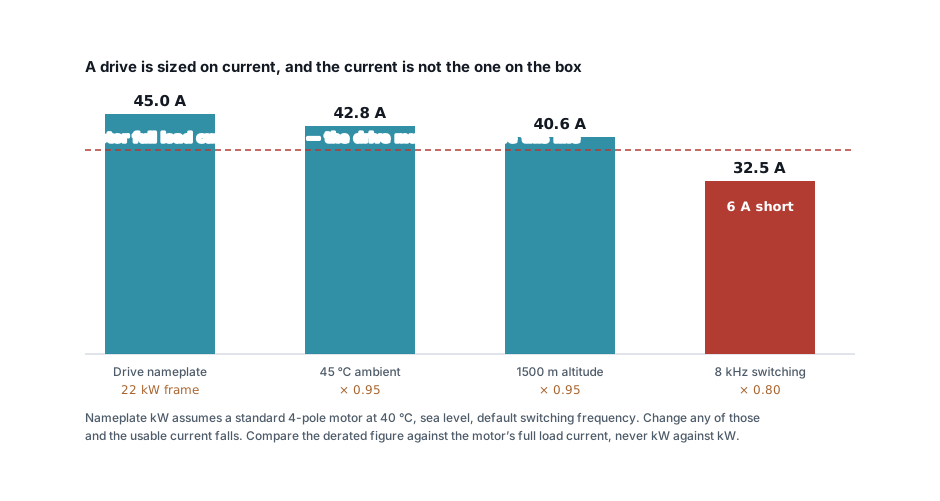
Choosing a VFD: what actually decides the size
Drives are sized on current, not kW — and the current on the box is before derating. Overload class, control mode, cable length and harmonics.
7 min read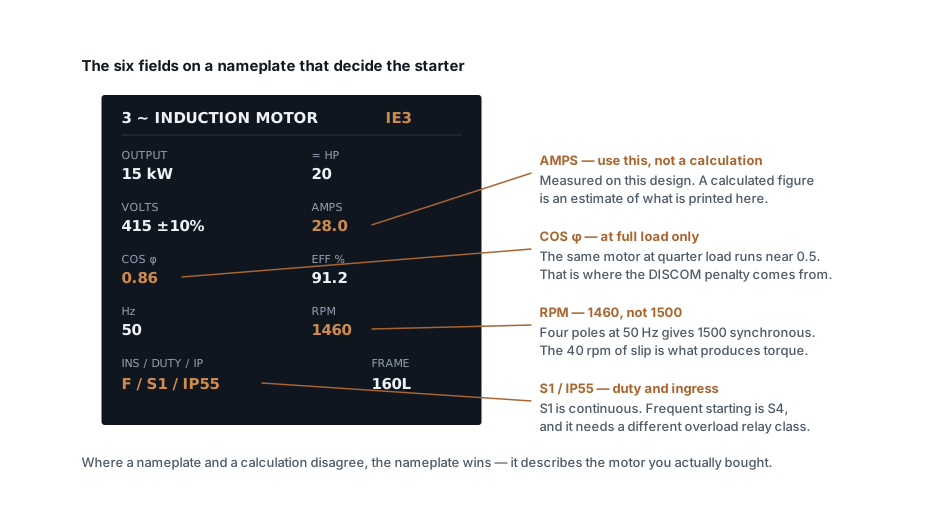 Motors & starting
Motor full load current at 415 V: the chart, and the caveats
Full load current for standard three-phase motors from 0.75 to 160 kW, with contactor, relay and cable figures — and why the nameplate rarely matches the table.
9 min read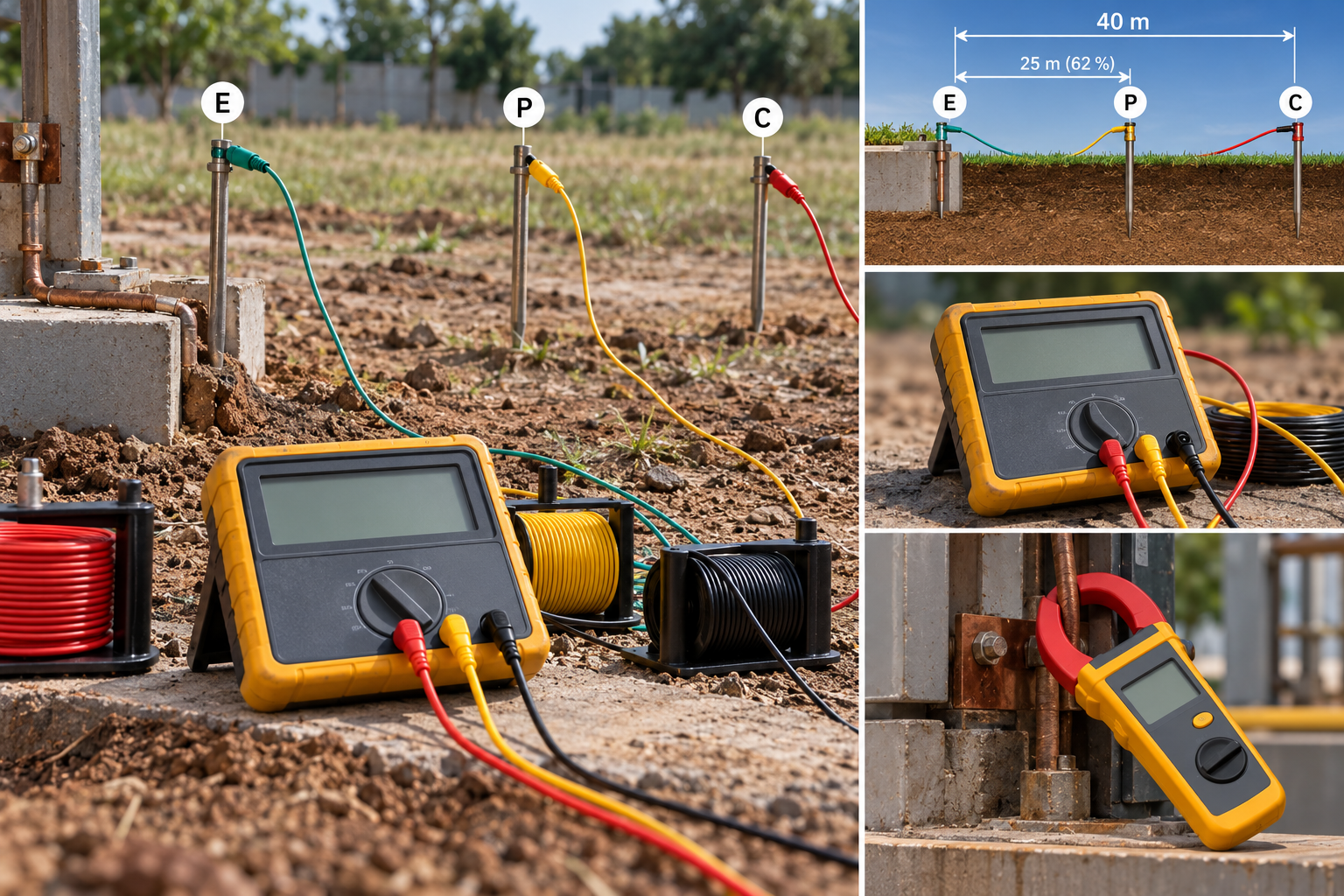 Panels, protection & earthing
Earth resistance testing: the 62 % rule, and when the clamp-on lies
Fall-of-potential done properly, the three-position check that proves it, IS 3043 limits by application, and when a clamp-on tester measures nothing.
8 min read Cable sizing
Cable size for large loads: when to run cables in parallel
Above 300 mm², a bigger cable size stops paying. When to run cables in parallel, the six rules for equal sharing, and the overload no breaker can see.
10 min read
Comments
Loading…