
DG set sizing: why motor starting usually governs
Two calculations decide a generator rating and most quotations do only one. A worked example where the starter choice halves the frame size.
Ask for a DG quotation and you will usually be asked one question: what is the load? Add up the kW, divide by power factor, add a margin, pick the next standard rating. That covers the set running steadily, and it says nothing about the moment somebody presses the start button on the largest motor — which is when generators actually misbehave.
There are two calculations. The rating you need is the larger of them, and on plants with one big motor it is usually the second.
Calculation one: the running load
Straightforward, and the one everybody does.
Running kW  = connected load × demand factor
Running kVA = running kW / power factor
Required    = running kVA × (1 + future margin)
Take a plant with 120 kW connected, a demand factor of 0.7 and a power factor of 0.8:
84 kW running → 105 kVA → 121 kVA with 15 % margin
Two things to be careful about. The demand factor should come from measurement if the plant exists — see connected load, maximum demand and diversity. And the power factor matters more on a generator than on a utility supply, because an alternator is rated in kVA at 0.8 power factor and hits its current limit long before the engine runs out of kW.
Calculation two: the step load
When a large motor starts, it draws a very large current at a very poor power factor for a second or two. The alternator has to supply that transient without the voltage collapsing far enough to drop out the contactors — which is around 25 % dip in practice.
A brushless alternator will hold roughly 2.5 times its continuous rating for that period within an acceptable dip. So:
Step requirement = (other load already running, kVA)
                 + (starting kVA of the largest motor / 2.5)
Starting kVA depends entirely on how the motor is started:
| Starting method | kVA per kW of motor |
|---|---|
| Direct on line | 8.5 |
| Star–delta | 2.9 |
| Soft starter | 3.9 |
| VFD | 1.5 |
Continue the example with a 45 kW motor as the largest single load:
Direct on line:
  Starting kVA   = 45 × 8.5 = 382 kVA
  Other load     = 105 − (45 / 0.8) = 49 kVA
  Step required  = 49 + 382 / 2.5 = 202 kVA     ← governs

Star–delta:
  Starting kVA   = 45 × 2.9 = 130 kVA
  Step required  = 49 + 130 / 2.5 = 101 kVA     ← running load governs at 121
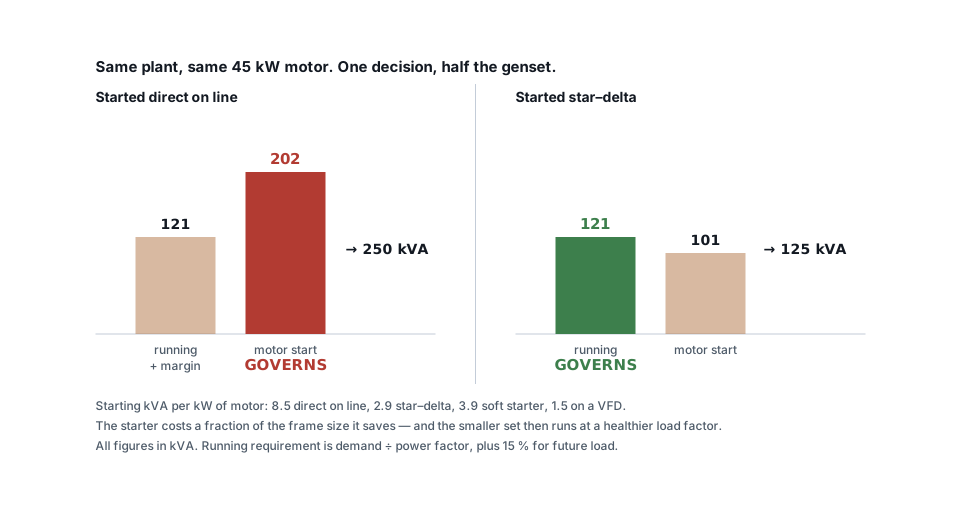
A 250 kVA set against a 125 kVA set, decided entirely by the starter. A star–delta starter or a soft starter on that one motor costs a fraction of the difference between the two frame sizes — and the smaller set then runs at a healthier load factor for the rest of its life. The DG sizing calculator runs both calculations and tells you which one governed.
The same logic applies in reverse when a plant is already built: if a genset browns out on motor starting, changing the starter is nearly always cheaper than changing the generator.
Derate for the site
The engine is an air pump. Thinner, hotter air means less power:
- Roughly 3 % per 300 m of altitude above 1,000 m.
- Roughly 2 % per 5 °C of ambient above 40 °C.
A set installed at 1,800 m in a hot summer can be 15 % down on its nameplate. The derating applies at your site, so the ordered rating must exceed the calculated requirement, not equal it.
Read the rating definition, not just the number
ISO 8528 defines three ratings, and a quotation usually shows the largest one:
| Rating | Means | Typical relationship |
|---|---|---|
| Standby (ESP) | Emergency use, varying load, no overload capability | The headline figure |
| Prime (PRP) | Unlimited hours, varying load, 10 % overload for 1 hour in 12 | ~90 % of standby |
| Continuous (COP) | Unlimited hours at constant load | ~80 % of standby |
If the set is genuinely a backup that runs during outages, size against standby. If it is your regular supply — common on sites with poor grid availability — size against prime, or you will be running an emergency-rated machine continuously and its maintenance interval will tell you so.
There is also a load acceptance class (G1 to G4) covering how much step load the set will take and how fast it recovers. G2 suits general industrial and commercial use; G3 and G4 are for sensitive loads. If you have a large step load relative to the set, this class is worth specifying rather than assuming.
Load factor, fuel and the cost of oversizing
An oversized diesel is not a safe choice, it is a different problem. Below about 30 % load a diesel runs cool, burns fuel incompletely and wet-stacks — unburnt fuel and carbon accumulate in the exhaust, injectors glaze, and maintenance cost climbs. Aim for 60–80 % load in normal running.
Fuel consumption is roughly:
| Load | Litres per kWh |
|---|---|
| 100 % | 0.25 |
| 75 % | 0.27 |
| 50 % | 0.30 |
| 25 % | 0.38 and rising |
Over a year of daily running, the gap between a well-loaded set and a lightly loaded one is usually larger than the price difference between the two sets.
If the load genuinely varies that much, two smaller sets in synchronism beat one large one: run one at good load factor most of the time and bring the second in at peak. It costs more to buy and it is cheaper to own, and it gives you redundancy that a single set cannot.
Capacitors and generators do not mix casually
A capacitor bank sized for the utility supply can destabilise a generator. On a lightly loaded set, a large fixed bank drives the power factor leading, the AVR hunts, and voltage becomes unstable.
Switch the bank out when running on DG, or use an APFC controller that is told which source is live and adjusts its target accordingly. This is a two-wire interlock at the changeover, and it gets forgotten on most retrofits.
Non-linear load needs more alternator than you think
Motor starting is the case everyone eventually hears about. The one that catches modern installations is UPS and drive load, and it fails differently: nothing stalls, the voltage waveform just deteriorates until sensitive equipment starts misbehaving for reasons nobody can trace.
A generator is a much weaker source than the grid. Its subtransient reactance is typically 12–18 %, against something nearer 5 % for a distribution transformer, so the same harmonic current produces three times the voltage distortion. Load that behaves perfectly on mains can push total voltage distortion into double figures on a genset.
The usual guidance is to keep non-linear load below about a third of the set rating, and to oversize where it is higher — for a UPS with a six-pulse front end, sizing the alternator at 1.5 to 2 times the UPS rating is common advice from set manufacturers. The cheaper fix is usually at the load: a twelve-pulse or active front end, or input reactors on the drives, cuts the harmonic current at source and lets you buy the smaller set.
If the site has significant drive load, ask the genset supplier for the alternator's harmonic derating explicitly rather than accepting the standard rating. It is a question they expect.
Before you release the order
- Both calculations done, and you know which one governed.
- Demand measured rather than estimated, where the plant exists.
- Power factor corrected before sizing, not after.
- Starting method for the largest motor decided — it may be the cheapest decision on the project.
- Derating applied for altitude and ambient at the actual site.
- Rating definition confirmed: standby, prime or continuous.
- Expected load factor between 60 % and 80 %.
- Capacitor bank interlocked to the changeover.
Run your own figures through the DG sizing calculator — it does both calculations, applies the deratings, snaps to standard Indian frame sizes and shows the fuel burn at the resulting load point.
Standards referenced
- ISO 8528 — Reciprocating internal combustion engine driven alternating current generating sets. ISO
Titles are given as commonly published. Check the current edition with the publisher before relying on a clause in professional work.
Related articles
More on supply, demand & generation.
 Supply, demand & generation
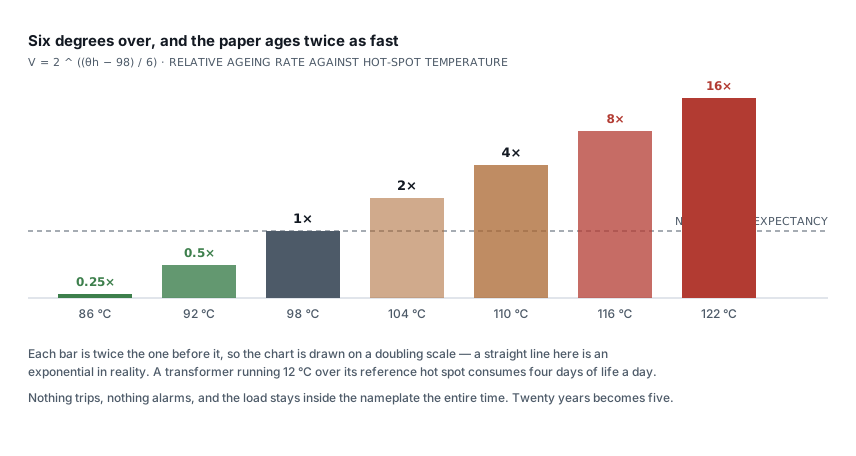
Why distribution transformers fail: one mechanism, ten routes to it
Almost every failure mode ends as heat or water in the paper. The 6 °C rule that quantifies it, and the oil tests that see it coming months ahead.
8 min read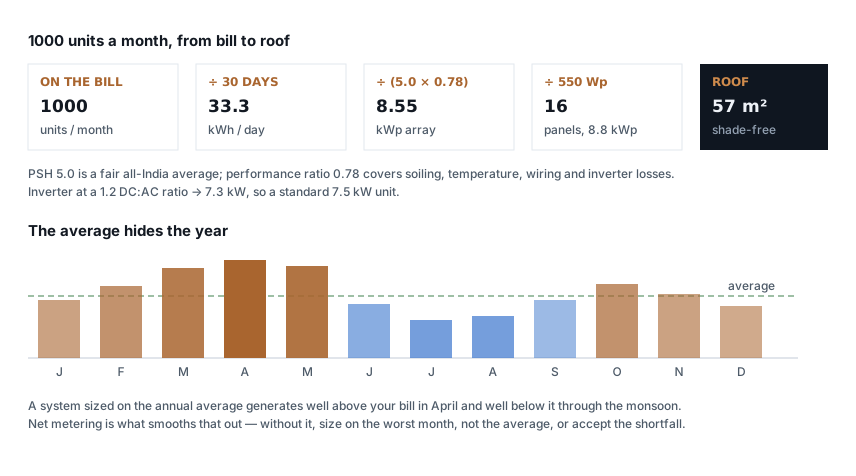 Supply, demand & generation
How many solar panels for 1000 units a month?
The arithmetic from your bill to a panel count and a roof area, why the annual average misleads, and the four things that decide whether you actually get it.
6 min read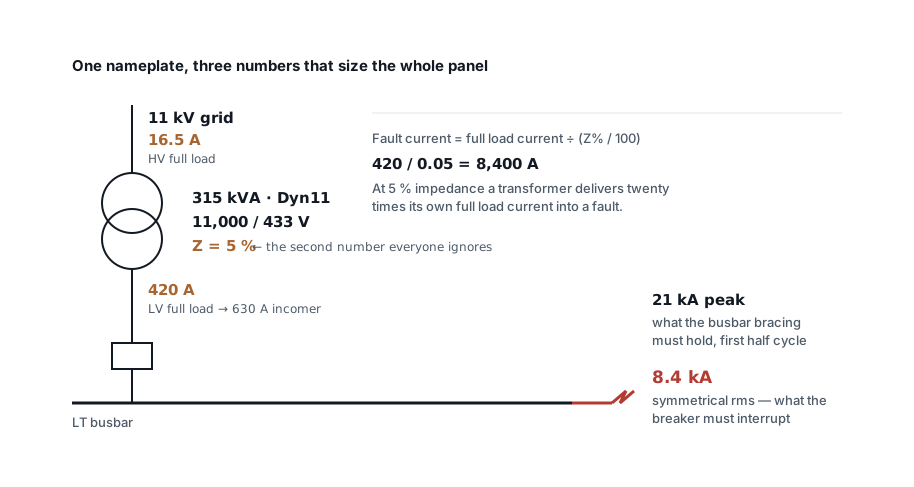 Supply, demand & generation
Sizing a distribution transformer: kVA, %Z and fault level
Size a distribution transformer from maximum demand, not connected load — and why the per cent impedance on the nameplate is what decides your switchgear.
10 min read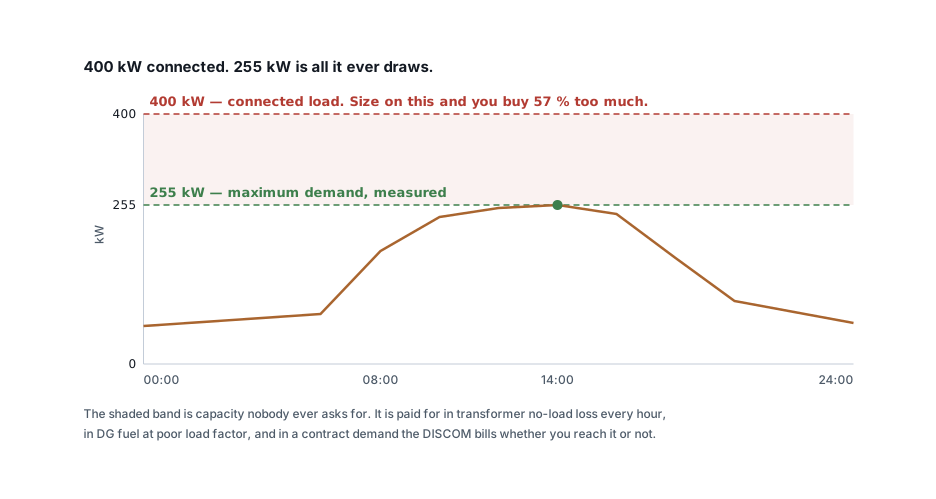 Supply, demand & generation
Connected load, maximum demand and diversity factor
The three numbers get used as though they were one. Which to size on, typical demand factors by load type, and what getting it wrong costs on the bill.
7 min read
Comments
Loading…