
How many solar panels for 1000 units a month?
The arithmetic from your bill to a panel count and a roof area, why the annual average misleads, and the four things that decide whether you actually get it.
It is the first question anyone asks, and it has a real answer: around 8.5 kWp — roughly 16 panels and 57 m² of shade-free roof.
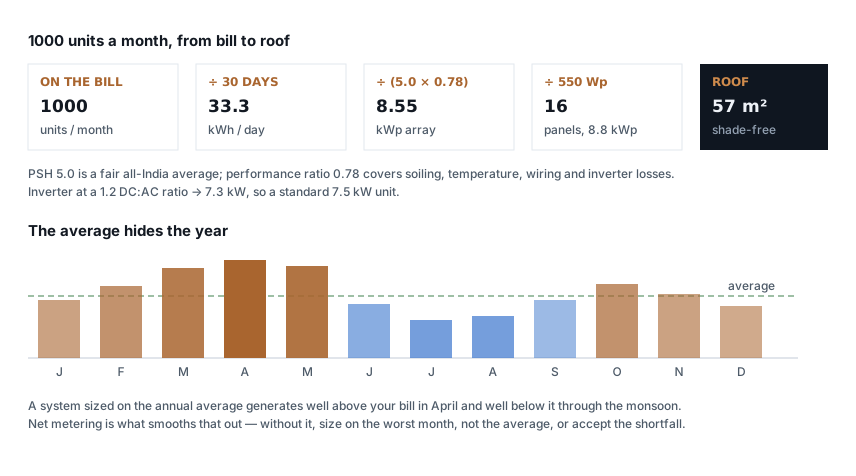
Getting there takes four lines of arithmetic. Knowing whether you will actually see 1000 units a month takes rather more, because the average hides a year that swings 40 % from peak to trough.
The arithmetic
1000 units / month ÷ 30            = 33.3 kWh per day
33.3 ÷ (peak sun hours × PR)       = array kWp
33.3 ÷ (5.0 × 0.78)                = 8.55 kWp
8,550 W ÷ 550 Wp per panel         = 16 panels (8.8 kWp installed)
8.8 kWp × 6.5 m² per kWp           = 57 m² of roof
Two inputs carry all the uncertainty.
Peak sun hours (PSH) is the number of hours per day of full 1 kW/m² sunshine that would deliver the same energy your location actually receives. It is not hours of daylight.
| Region | Typical PSH |
|---|---|
| Rajasthan, Gujarat, Ladakh | 5.5 – 6.0 |
| Central and southern India | 5.0 – 5.5 |
| Indo-Gangetic plain | 4.5 – 5.0 |
| Kerala, north-east, hill stations | 4.0 – 4.5 |
Performance ratio (PR) is everything that stands between the panel's laboratory rating and delivered energy: temperature, soiling, wiring loss, inverter efficiency, mismatch, downtime. 0.78 is a fair figure for a well-installed rooftop system in India. Anyone quoting 0.85 is optimistic; anyone quoting 0.70 is describing a dusty roof.
Panel temperature is the biggest single term, and it is why the hottest month is not the best month. A panel rated at 25 °C runs at 60 °C on an Indian roof in May and loses around 12–15 % of its output doing so.
Put your own numbers in with the solar sizing calculator — it returns array kWp, panel count, inverter rating and roof area together.
The average hides the year
A system sized on the annual average over-produces from February to May and under-produces through the monsoon. July generation can be 40 % below April's.
That matters for how you are billed:
- With net metering, the surplus you export in April offsets what you import in July, and sizing on the annual average is exactly right.
- Without it — gross metering, or a purely self-consumption system — the surplus is wasted and the shortfall is bought from the grid. Sizing on the average means never quite covering the bad months.
Net metering rules, capacity caps and settlement periods are set by state regulations and revised regularly. Check your DISCOM's current policy before sizing, because it changes the right answer rather than just the paperwork.
What actually limits the system
Shade-free area, not total area. 57 m² is the panel area. Real roofs need walkways, inter-row spacing so one row does not shade the next in winter, and clearance from parapets, tanks and stair headroom. Budget 1.3 to 1.5 times the panel area for a flat roof; a sloped roof facing the right way needs less.
A single panel in shade drags down its whole string. Bypass diodes limit the damage, and module-level power electronics or a multi-string inverter limits it further, but the honest answer is to keep the array out of shade — including the shade of a water tank at four in the afternoon in December, which is not where anyone looks when surveying in June.
Orientation. South-facing is optimal in India. East or west costs roughly 10–15 %. Tilt near the site latitude gives the best annual yield; a shallower tilt favours summer, a steeper one favours winter.
Structure. The mounting has to survive local wind loading, and a roof has to be capable of carrying it. On older buildings this is a genuine engineering check, not a formality.
Inverter sizing. A DC:AC ratio around 1.2 is standard — the array is deliberately larger than the inverter, because full output happens for very few hours a year and slightly clipping that peak costs less than the bigger inverter. For 8.8 kWp that is a 7.5 kW inverter. Also check the string voltage against the inverter's MPPT window at your coldest expected temperature: panel voltage rises as temperature falls, and an over-long string can exceed the inverter's maximum on a cold clear morning.
What it does to your bill is not proportional
A system covering your full consumption rarely removes your full bill, and the reason is the tariff structure rather than the panels.
Most Indian tariffs are slabbed, and the units solar removes are the ones at the top slab — the expensive ones. That works in your favour: the first units you displace are worth more than the average rate on your bill.
Working against you are the charges that solar does not touch. Fixed charges based on sanctioned load, and demand charges on commercial and industrial connections, are levied whether you generate or not. On a commercial connection where demand charges are a large share of the bill, a system sized to cover 100 % of your units might remove 60–70 % of the rupees.
Work from the actual bill, line by line, rather than from the total. It changes the payback, and it occasionally changes the right system size. The electricity bill calculator prices consumption through your own slab rates, which is the number to run the comparison against.
Do you want batteries?
Different question, and usually a different answer.
A grid-tied system with net metering uses the grid as its store, at no capital cost. Batteries only earn their place when you need backup during outages, or when your tariff has time-of-day rates worth arbitraging.
If you do want backup, size the bank from the load you actually need to carry during an outage — not from the solar array. A few essential circuits for a few hours is a very different bank from whole-house autonomy. The battery bank calculator applies the depth of discharge and C10 rate effects that make published Ah figures misleading.
What to check before signing a quotation
- Twelve months of bills, not one. Your consumption has a season too, and it may not line up with the generation season.
- Sanctioned load and net metering cap. Many states limit rooftop capacity to a percentage of sanctioned load. A system larger than the cap cannot be commissioned as you intended.
- PR and PSH stated in the quotation. If a supplier's generation estimate does not name both, it is not an estimate — and quotations that promise 1,500 kWh per kWp per year in a 5.0 PSH location are describing a PR above 0.82.
- Degradation. Panels lose roughly 0.5 % of output a year; a 25-year warranty typically guarantees 80–85 % at end of term. Size for what you need in year ten, not year one.
- Cleaning access. Soiling can cost 5–15 % in dusty locations between washes. A system you cannot safely reach is a system that will not be cleaned.
- Subsidy rules. Residential rooftop subsidy schemes exist and their terms — eligibility, capacity limits, empanelled vendors — change. Confirm the current scheme before it forms part of your payback calculation.
The arithmetic at the top of this post is the easy part and it is reliable. The gap between 8.5 kWp on paper and 1000 units a month in practice is shade, soiling, orientation and policy — which is where a site survey earns its money.
Related articles
More on supply, demand & generation.
 Supply, demand & generation
Why distribution transformers fail: one mechanism, ten routes to it
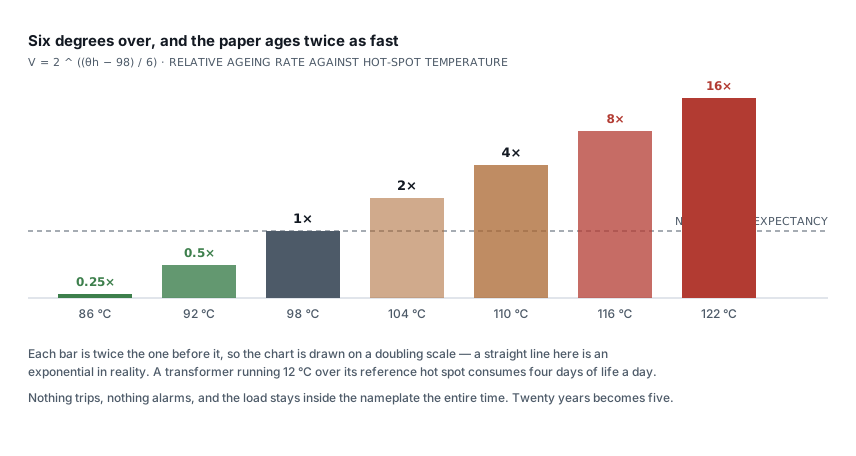
Almost every failure mode ends as heat or water in the paper. The 6 °C rule that quantifies it, and the oil tests that see it coming months ahead.
8 min read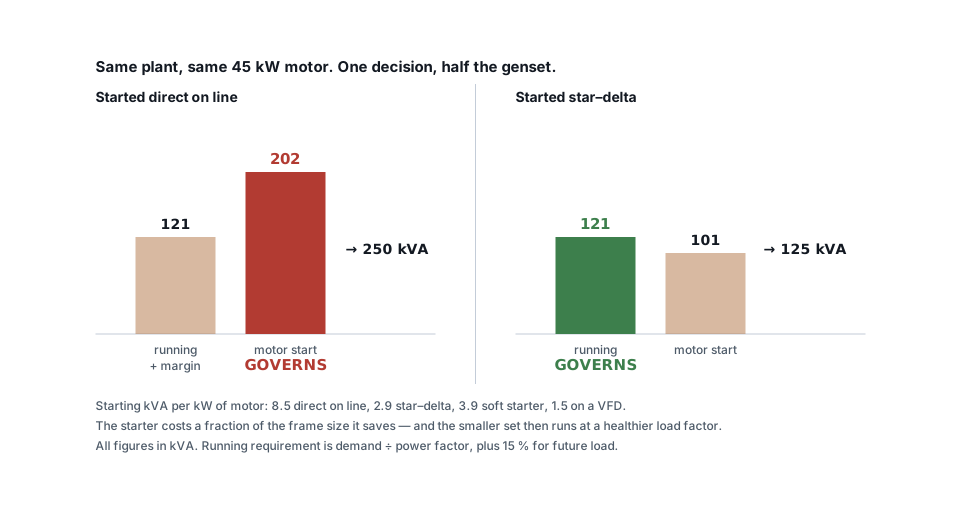 Supply, demand & generation
DG set sizing: why motor starting usually governs
Two calculations decide a generator rating and most quotations do only one. A worked example where the starter choice halves the frame size.
7 min read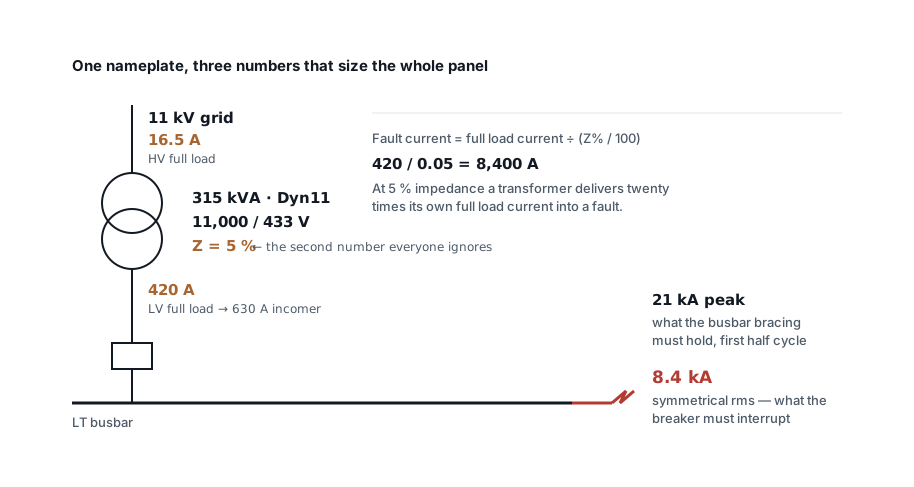 Supply, demand & generation
Sizing a distribution transformer: kVA, %Z and fault level
Size a distribution transformer from maximum demand, not connected load — and why the per cent impedance on the nameplate is what decides your switchgear.
10 min read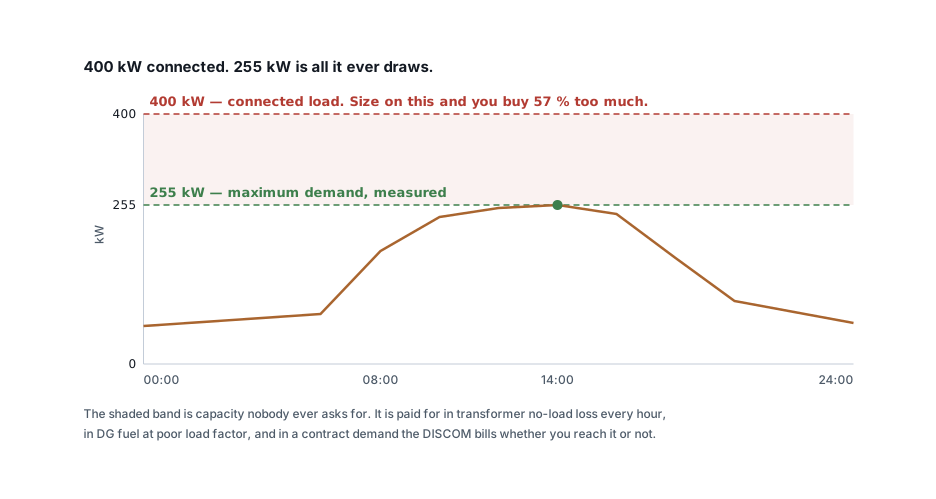 Supply, demand & generation
Connected load, maximum demand and diversity factor
The three numbers get used as though they were one. Which to size on, typical demand factors by load type, and what getting it wrong costs on the bill.
7 min read
Comments
Loading…