
Why distribution transformers fail: one mechanism, ten routes to it
Almost every failure mode ends as heat or water in the paper. The 6 °C rule that quantifies it, and the oil tests that see it coming months ahead.
There is a list that circulates every few months: ten things that kill distribution transformers. Oil leakage, insulation breakdown, overloading, lightning, bushing failure, tap changer trouble, core ground faults, short-circuit stress, animals, corrosion.
The list is accurate. It is also arranged in a way that hides the useful part, because nine of those ten are not failure modes at all — they are routes to the same one.
A transformer's life is the life of the paper wound around its conductors. That paper fails when it gets hot, or when it gets wet, and almost everything on the list is a way of arranging one of those two things. Oil leakage matters because oil cools and insulates. Blocked radiators matter for the same reason. A core ground fault matters because circulating current makes heat somewhere it was not designed to appear. Corrosion matters because it eventually lets water in.
Once you see it that way, the maintenance question stops being "which of ten things do I watch for" and becomes something you can actually measure: how hot is the paper, how wet is it, and how fast is it ageing.
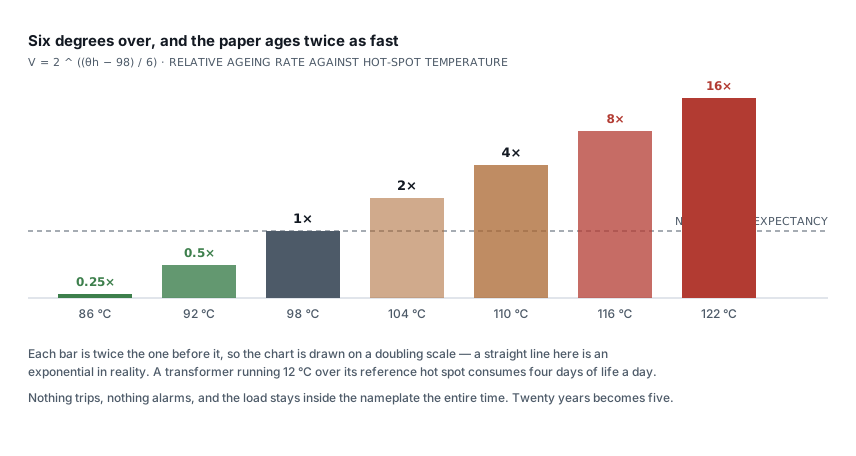
The 6 °C rule, which is the number worth memorising
Insulation ageing is a chemical reaction, and reaction rates climb exponentially with temperature. For the kraft paper in an oil-immersed transformer, the relationship is close enough to a doubling for every 6 °C rise that the loading guides use it directly:
V = 2 ^ ((θh − 98) / 6)

V  = relative rate of ageing
θh = hot-spot temperature, °C
98 = reference hot spot for normal life expectancy
Put numbers through it and the consequence is stark:
| Hot spot | Ageing rate | Meaning |
|---|---|---|
| 86 °C | 0.25 | Four times the design life |
| 92 °C | 0.5 | Twice the design life |
| 98 °C | 1.0 | Normal life expectancy |
| 104 °C | 2 | Half the design life |
| 110 °C | 4 | A quarter |
| 116 °C | 8 | An eighth |
| 122 °C | 16 | A sixteenth |
A transformer run 12 °C above its reference hot spot does not lose a little life. It uses four days of life every day. Twenty years becomes five, and the failure arrives with no warning that anybody was looking for — because nothing tripped, nothing alarmed, and the load was inside the nameplate the whole time.
This also explains the thing that confuses people about overloading: a transformer can be overloaded for hours without harm and destroyed by a load it carries continuously. What consumes life is the integral of temperature over time, not the peak.
Ambient is half the hot spot
The hot spot is ambient temperature, plus the oil's rise over ambient, plus the winding's rise over the oil. The nameplate rating assumes an ambient the manufacturer chose — and in India that assumption is routinely wrong by a wide margin.
A pole-mounted transformer in full sun in Rajasthan in May is not sitting in the average annual ambient the rating was derived from. Neither is one in a substation yard with no airflow, or one boxed into a compact substation enclosure that was sized for the transformer and not for the heat it produces.
The practical version: the same transformer carrying the same load has a different life in Pune and in Nagpur, and the difference is not marginal. If you are sizing a unit, size it against the ambient it will actually live in. The transformer sizing calculator works from load and impedance; the ambient is the judgement you bring to it.
Water, the other half
Moisture does three things, all bad. It reduces the dielectric strength of the oil, so the margin against flashover shrinks. It attacks the paper directly, accelerating the same ageing reaction that heat drives. And it migrates: as the transformer heats and cools, water moves between oil and paper, so an oil sample taken hot and one taken cold tell you different stories about the same machine.
The commonest route in is the breather. Silica gel that has gone pink is not a housekeeping item to attend to at the next opportunity — it is an open door. Every load cycle breathes damp air across it. On a transformer without a conservator, the route in is the gasket that has been weeping oil for two years, because whatever lets oil out lets moisture in.
What actually warns you: the oil is a witness
Here is what the ten-item list promises and never delivers. It says failures give early warning. It does not say what the warning is or how to read it.
Dissolved gas analysis is the answer. Faults inside a transformer crack the oil and the paper into characteristic gases, and which gases appear tells you what kind of fault is running:
| Gas | What it indicates |
|---|---|
| Hydrogen | Partial discharge — corona activity |
| Methane, ethane | Overheating at low temperature |
| Ethylene | Overheating at high temperature, above about 300 °C |
| Acetylene | Arcing. Needs temperatures above roughly 700 °C |
| Carbon monoxide, carbon dioxide | The paper itself is degrading, not just the oil |
Acetylene is the one to know. Oil does not produce it at any temperature a healthy transformer reaches, so its presence in any meaningful quantity means something is arcing inside a tank you cannot see into. A rising acetylene trend is a transformer telling you it is going to fail, months ahead, in a language that costs a few thousand rupees a sample to read.
Interpretation is not done gas by gas but by ratios — the Duval triangle and the Rogers ratios, both set out in IEC 60599. Any competent oil laboratory returns the interpretation with the numbers.
Two things matter more than the absolute values: trend and rate. One sample is a data point. Three samples over eighteen months is a diagnosis. A gas level that is high but flat is usually an old, stable fault; a moderate level climbing steadily is the dangerous one.
Three tests that pay for themselves
For a distribution transformer, an annual oil sample covering:
- Breakdown voltage (BDV) — measured across a standard gap per IEC 60156. Falling BDV means moisture, particles, or both. It is the cheapest single indicator of insulation health.
- Moisture content, in ppm, interpreted against the oil temperature at sampling. Without the temperature the number means little.
- Dissolved gas analysis, as above.
Add furan analysis where a unit is old or valuable: 2-furfural in the oil correlates with the degree of polymerisation of the paper, which is the closest thing to a direct measurement of remaining life. It is the test that answers "should we replace this one" rather than "is this one faulty".
Check the acceptance limits against the standard current in your utility rather than against a number from an article — they vary by voltage class and by whether the oil is new, reconditioned or in service.
Where surge protection actually fails
Lightning appears on every list and the mitigation is always "fit surge arresters". They usually are fitted. They still fail to protect, and the reason is almost never the arrester.
An arrester is only as good as the path from its earth terminal to earth. It works by conducting the surge to ground; if that path has ten ohms of resistance and several metres of inductance, the arrester lifts the whole transformer tank to a high potential rather than clamping anything. The surge then finds the insulation anyway.
Two things follow. The arrester earth lead must be short and straight — every bend adds inductance, and at the microsecond timescale of a lightning impulse, inductance matters more than resistance. And the arrester earth and the transformer tank earth must be bonded together, so there is no potential difference between them for the surge to develop across. Two separate, unbonded electrodes is a common and expensive arrangement.
The earth electrode design itself is a separate discipline — see earthing design under IS 3043.
The cheap failures
Two on the list are genuinely their own thing, and both are cheap to prevent.
Animal intrusion is one of the largest causes of distribution outages anywhere, and it is a clearance problem. A bird bridging an HV bushing to the tank is a phase-to-earth fault. Bushing guards and animal barriers cost a fraction of one replacement, and they are the highest-return item on this page.
Corrosion is slow and visible, which is exactly why it is neglected. It ends as a leak, and a leak ends as low oil, and low oil ends as a hot spot. Painting a tank is not cosmetic maintenance.
What a real inspection contains
Not a list of ten things to worry about — a short list of things to record, with dates, so a trend exists:
- Oil level and any evidence of leaks, with the location noted
- Breather colour, and whether the oil cup is charged
- Load, ideally the maximum demand rather than a spot reading
- Ambient and tank temperature at the time of reading
- Silica gel, gaskets and paint condition
- Annual oil sample: BDV, moisture, DGA
The single most valuable thing on that list is the one nobody records: load alongside temperature and date. Without it there is no way to know whether the transformer is ageing at half rate or four times rate, and that ratio is the difference between a unit that reaches thirty years and one that fails in the eighth.
A transformer rarely fails from one event. It fails because it spent years a few degrees hotter than anybody measured.
Standards referenced
- IS 3043 — Code of Practice for Earthing. Bureau of Indian Standards
Titles are given as commonly published. Check the current edition with the publisher before relying on a clause in professional work.
Related articles
More on supply, demand & generation.
 Supply, demand & generation
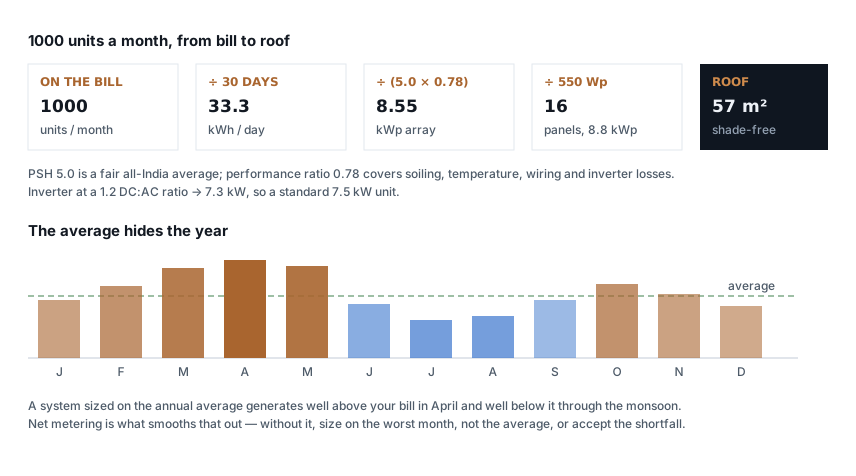
How many solar panels for 1000 units a month?
The arithmetic from your bill to a panel count and a roof area, why the annual average misleads, and the four things that decide whether you actually get it.
6 min read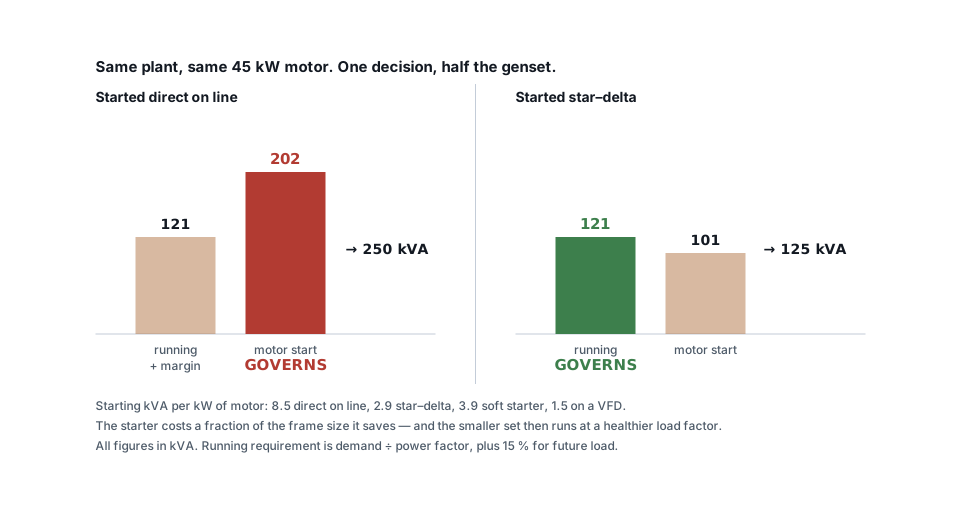 Supply, demand & generation
DG set sizing: why motor starting usually governs
Two calculations decide a generator rating and most quotations do only one. A worked example where the starter choice halves the frame size.
7 min read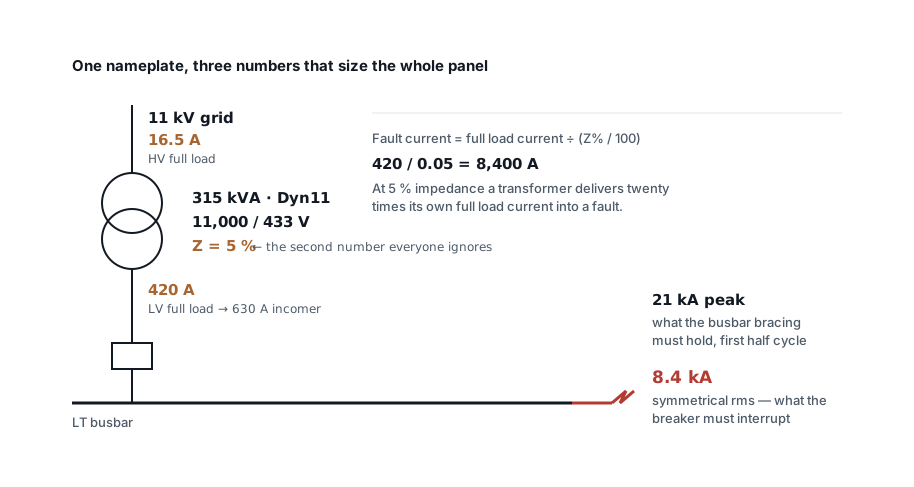 Supply, demand & generation
Sizing a distribution transformer: kVA, %Z and fault level
Size a distribution transformer from maximum demand, not connected load — and why the per cent impedance on the nameplate is what decides your switchgear.
10 min read Supply, demand & generation
Connected load, maximum demand and diversity factor
The three numbers get used as though they were one. Which to size on, typical demand factors by load type, and what getting it wrong costs on the bill.
7 min read
Comments
Loading…