
Connected load, maximum demand and diversity factor
The three numbers get used as though they were one. Which to size on, typical demand factors by load type, and what getting it wrong costs on the bill.
Three terms turn up on every load schedule, and they get used interchangeably by people who should know better. They are not the same number, they are not interchangeable, and choosing the wrong one sizes a transformer, a DG set and a DISCOM contract that you will pay for every month for twenty years.
Here is what each one means, what factors to apply, and where the money is.
The three terms
Connected load is the sum of every nameplate on site. Every motor, every light, every socket circuit, at full output, all at once. It is a real number and it is easy to calculate, which is why people use it. It describes a situation that never occurs.
Maximum demand is the highest average load over a defined interval — normally 15 or 30 minutes, because that is what the utility's meter records. This is what the supply must actually deliver, and it is the number to size on.
Demand factor connects them:
Demand factor = maximum demand / connected load
Diversity factor is the one that gets muddled. It is not the same thing:
Diversity factor = sum of individual maximum demands / coincident maximum demand
It is always greater than or equal to 1, because the parts of an installation do not all peak at the same moment. The canteen peaks at lunch, the HVAC peaks at three in the afternoon, the car park lighting peaks at night. Add their individual peaks together and you get a number nobody ever draws.
If a figure you have been handed is less than 1, it is a demand factor whatever the drawing calls it.
Typical demand factors
Starting points for a commercial or light industrial building. They are judgement, and the last section of this post explains how to replace them with something better.
| Load | Demand factor | Why |
|---|---|---|
| Lighting, offices | 0.9 | Nearly all on together during the day |
| Lighting, warehouse | 0.6 | Zoned, and much of it stays off |
| Socket outlets, general | 0.2–0.3 | Sockets are provisioned, not used |
| HVAC / chillers | 0.8 | Runs continuously, modulates rather than stops |
| Lifts | 0.4–0.5 | Intermittent, and never all rising together |
| Kitchen equipment | 0.5–0.6 | Heavily cyclic |
| Process motors, continuous | 0.8–0.9 | Sized close to their duty |
| Process motors, batch | 0.5–0.7 | Depends entirely on the process |
| Welding sets | 0.3–0.5 | Very low duty cycle, very high peak |
| Fire pumps, standby | 0.0–0.2 | Excluded from normal demand — but see below |
| EV chargers | 0.6–1.0 | Rising, and load management changes it completely |
Socket outlets are where estimates diverge most. A floor with sixty twin sockets has a connected load in the tens of kilowatts and a real demand of a few. Nobody plugs a 13 A load into every socket.
Fire pumps and sprinkler sets are excluded from maximum demand because they only run in an emergency — but the supply, the cable and the switchgear must still be capable of carrying them. Exclude them from the demand calculation and include them in the capability check.
Worked example: an office building
| Load | Connected | Factor | Demand |
|---|---|---|---|
| Lighting | 45 kW | 0.90 | 40.5 kW |
| Small power / sockets | 60 kW | 0.30 | 18.0 kW |
| HVAC | 180 kW | 0.80 | 144.0 kW |
| Lifts, 3 × 15 kW | 45 kW | 0.50 | 22.5 kW |
| Canteen | 40 kW | 0.60 | 24.0 kW |
| Fire pumps (standby) | 30 kW | 0.20 | 6.0 kW |
| Total | 400 kW | 0.64 | 255 kW |
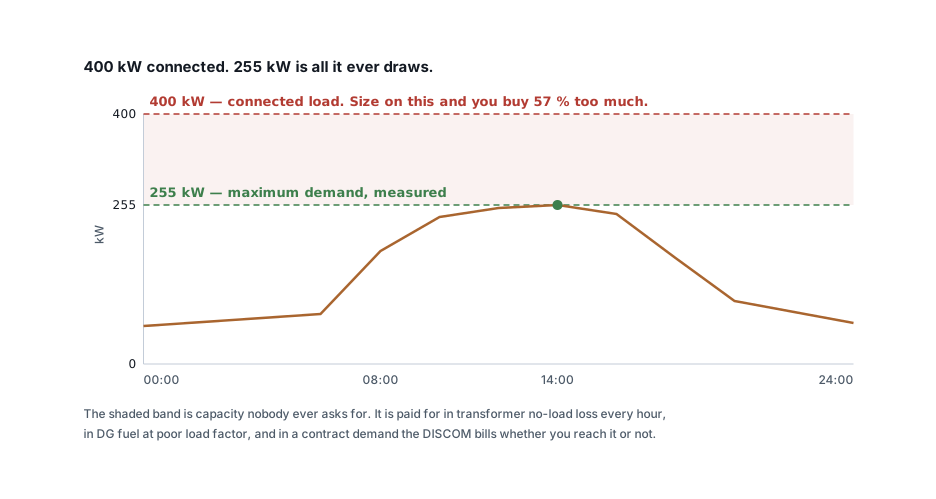
At 0.9 power factor that is 283 kVA. Add 15 % for future load and you are looking for 326 kVA — a 400 kVA transformer, with the transformer sizing calculator confirming the loading lands at a healthy 71 %.
Size the same building on connected load and you specify 400 kW / 0.9 = 444 kVA, plus margin, and buy a 630 kVA transformer. That is one frame size larger, a larger HT breaker, a larger incomer, and no-load losses running around the clock for a capacity the building will never ask for.
Where the money actually is
Oversizing costs more than the extra capital, and most of it is recurring.
Contract demand. Indian industrial and commercial tariffs bill a demand charge on contracted kVA, every month, whether you draw it or not. Contract for 400 kVA and peak at 283 and you are paying for 117 kVA of nothing. Contract too low and you pay a penalty on the excess — typically 1.5 to 2 times the normal demand rate — so the correct number matters in both directions.
Transformer no-load loss. Present from the moment the HV is charged, independent of load, and larger on a larger unit. Over a thirty-year life it is a substantial figure.
DG fuel. A generator sized on connected load runs at a low load factor. Below about 30 % load, a diesel wet-stacks, glazes its bores and costs more in maintenance than the fuel it saved. The DG sizing calculator sizes against demand and against the largest motor start, which is usually what governs anyway.
Cable and switchgear. Everything downstream is chosen from the same wrong number.
Stop guessing when you can measure
Every factor in this post is a substitute for data. If the installation exists in any form, better data is available:
- The electricity bill. Indian commercial and industrial tariffs print recorded maximum demand every month. Twelve bills give you the annual peak and the seasonal shape for free.
- The meter itself. Most LT trivector and smart meters hold MD registers and a load survey, readable over Modbus RTU or from the DISCOM's portal.
- A clamp meter and a fortnight. A logging clamp on the incomer, left for two weeks including a Monday and a weekend, beats any table.
For an extension, measure the existing demand and add the new load with its own factor — do not re-estimate the whole building. The existing plant has already told you what it draws.
Three mistakes worth naming
Applying a diversity factor twice. Once at the sub-board level and again at the main board is a common spreadsheet error, and it produces a supply that is genuinely too small. Apply diversity once at each level of aggregation, and be explicit about which level a factor belongs to.
Forgetting that demand is measured in kVA, not kW. The utility bills apparent power. A 255 kW demand at 0.75 power factor is 340 kVA of contract demand; at 0.95 it is 268 kVA. Correcting power factor reduces contract demand directly — see what the penalty costs — and on many tariffs that saving alone repays the capacitor bank inside a year.
Assuming diversity where there is none. A process line where every motor starts on the same signal has a demand factor near 1.0. A data centre runs flat out at three in the morning. Diversity is an observation about how a building behaves, not a discount you are entitled to.
Convert your demand figure into current for the supply side with the three-phase current calculator, then size the transformer, the incomer and the cable from that one number — measured if you possibly can, estimated with the factors above if you cannot.
Related articles
More on supply, demand & generation.
 Supply, demand & generation
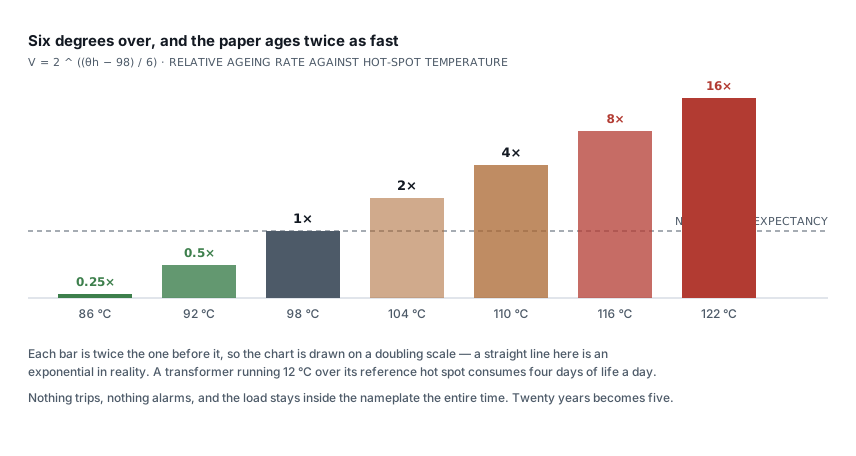
Why distribution transformers fail: one mechanism, ten routes to it
Almost every failure mode ends as heat or water in the paper. The 6 °C rule that quantifies it, and the oil tests that see it coming months ahead.
8 min read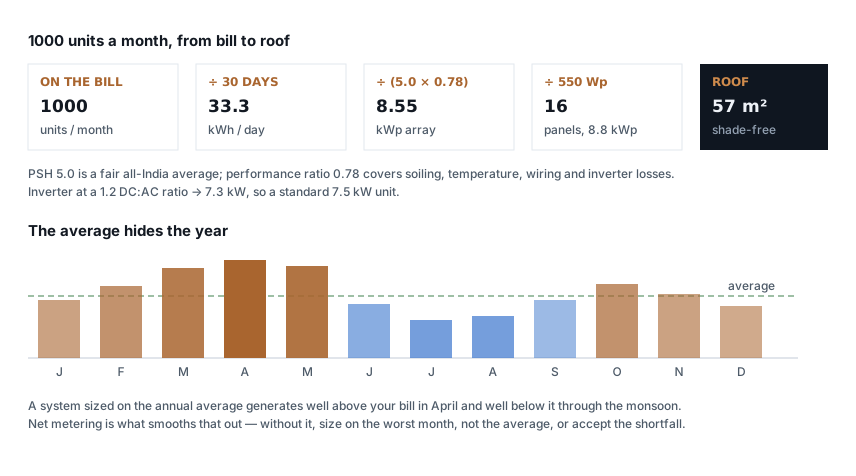 Supply, demand & generation
How many solar panels for 1000 units a month?
The arithmetic from your bill to a panel count and a roof area, why the annual average misleads, and the four things that decide whether you actually get it.
6 min read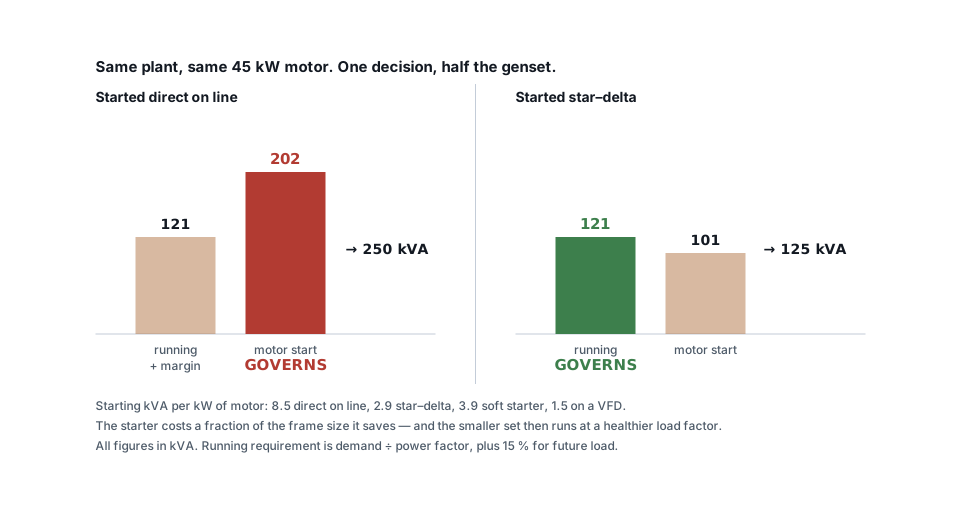 Supply, demand & generation
DG set sizing: why motor starting usually governs
Two calculations decide a generator rating and most quotations do only one. A worked example where the starter choice halves the frame size.
7 min read Supply, demand & generation
Sizing a distribution transformer: kVA, %Z and fault level
Size a distribution transformer from maximum demand, not connected load — and why the per cent impedance on the nameplate is what decides your switchgear.
10 min read
Comments
Loading…